National Account Spotlight: Visit The Village Sewing Center!

On today’s blog, we flew to California and went to visit our National Account Dealer, The Village Sewing Center in Santa Rosa, and got to meet their team and learn about their shop! Follow along as we meet up with Bernadette, a team member from the Village Sewing Center.

Opened in 1969, The Village Sewing Center is a well-known community sewing and quilting shop offering creators like you the tools, fabric, machines, and support you need to start bringing your ideas to life. Located in Santa Rosa, California, you can visit their shop filled with a variety of machines, ranging from your favorite home sewing machine, like our DX series, to our JUKI long-arm quilting J-350QVP Miyabi!

Follow along below for the transcript version of our interview with Bernadette from The Village Sewing Center.

Hi, I’m Bernadette, I work at Village Sewing Center, and we are located in Santa Rosa, California at 506 Lewis Rd. We are a sewing machine store, and we also sell fabrics and notions for sewing and quilting.

What Inspired You To Join The Village Sewing Center Team?

What inspired me to start working at Village Sewing Center? Village sewing center is a very community-based shop. John, the owner, is a friend of mine, and I just love the way he is so knowledgeable about sewing machines and just this industry. It’s a great place to get together with friends, and there’s a lot of comraderies and just support from all of our customers, and a great place to collaborate and be creative.

In knowing that, it’s really fun to work here and be a part of contributing to that.

What can customers look forward to at Village Sewing Center?

When you come to Village Sewing Center, we try to welcome you when you come through the door. It can be a very busy place, so we try to acknowledge all of our customers, and if a customer has a special need, we will do our best to try to fulfill that need, and find what the customer needs.

if we can’t, we also try to offer resources that can help them out so they can have what they need.

What can customers expect when shopping at Village Sewing Center?

You can find great service! Our service department is here on site, and we got really good service people that are trained by John and very knowledgeable about all the different sewing machines. We actually sell six or seven different brands here, but we service all brands. So that is one of the things you can find.

We also try really hard to educate our customers. If they are doing anything to the machine that is putting a little extra ware and tear on it that is something that we try and educate. Also, when you buy a machine from us, we give you classes. We offer classes, we offer phone support, and also if you come in and you’re having issues threading the machine or something like that, we will take the time to go on the floor and spend a few moments with you and show you how to do that.

Because what we really want you to do, is love the machine that you have and have the machine that is the right machine for you. That’s really important to us. Also, just the support that goes along with knowing how to use your machine so that you can get the most out of it, and so you can be a part of that sewing community and love it.

What are the benefits of being a Village Sewing Venter customer?

Okay, so the benefits that we offer; not only do we take care of your machine here at the store, but we also offer classes when you buy the machine with us. You’ll get a free class with the owner John; he also provides online classes in case it’s harder for you to come in. Basically, those classes are exactly the same as what you would get in the store, just in a video format.

Great classes, very informative!

We also offer trade-up! So if you buy a machine from us, and we have a couple things that you get that are a bit unusual in that first year when you buy a machine from us. Your first cleaning will be for free, and that helps us to get a chance to kinda look at what’s going on with the machine and inform you of how you can help it last longer. The other thing we offer is if you buy a machine from us and within that first year you decide it’s not the machine for you or you want to upgrade, within that first year, you can get a trade-up.

It doesn’t have to be the same brand, you can get a different brand if you like, but we support that so that you can end up with the machine, that’s the best machine for you.

What is your favorite JUKI machine?

The JUKI machine, my favorite machine, that’s a really hard thing to do because I like JUKI machines a lot. One of my very favorites is the JUKI TL-18QVP, I love it because its kind of an in-between between a home sewing machine and a professional machine, and it comes with all kinds of extra parts, so it’s just like a great machine to have that makes your sewing a whole lot easier.

I also love the longarm machine that we have. We have a smaller one, it’s like a 5-foot, and that one is such a great one if you’re getting into longarming. It’s super easy to use and just would make; I mean, I’m not even a free-motion quilter, but it makes me want to have one!

How can a customer find Village Sewing Center?

we hope to see you soon at Village Sewing Center! If you need to get a hold of us, you can call us at (707)-544-7529. You can also find us at our website www.villagesewing.com where you can also find our videos! And we are on Instagram, @VillageSewing also, and Facebook.

Thank you!

To learn more about The Village Sewing Center, visit their website here or socials down below! Thank you for joining us today in getting to know Bernadette and our National Account, The Village Sewing Center. We hope you get a chance to visit the next time you’re in the Santa Rosa area.
Instagram

Facebook

YouTube

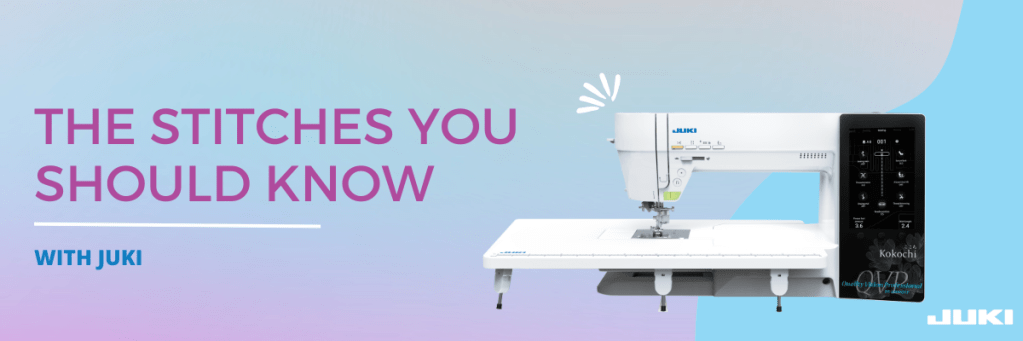
Know Your Stitches!

When we first try sewing, our first idea is to learn from project and instructional videos or reading pattern and sewing instruction books. One of the top things you’ll need to know about is the type of stitches you can create and when it’s time to use them on your projects! Depending on what machine you’re working on, whether you’ll be able to complete every stitch we mention below, and how you’ll be able to create it.

Let’s Get to Stitching!

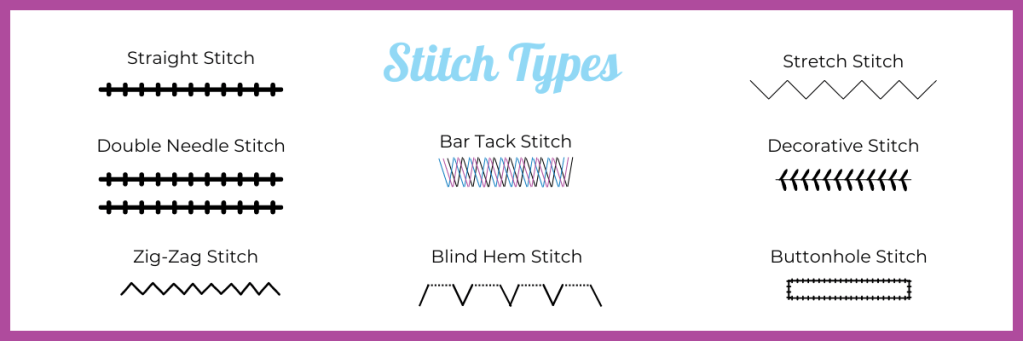
Straight Stitch: The straight stitch on all JUKI sewing machines is perfect for plain seams, darts, tucks, and topstitching! We recommend altering the stitch length to suit your project goals. The longer stitch lengths can be used for projects that require gathering or very long lengths for basting, making it easy to remove the stitches. Remember that your needle position should be set to the center of the presser foot for this to work.

Some machines will also offer a triple straight stitch. This is where the machines take 2 steps forward and one step back. This extra-strong stitch is excellent for crotches in pants where the seam is under extra stress.

Stitch Lengths to Know:

Seams and Majority Sewing: Length 2.0-3.0.

Gathering Fabric or Machine Basting Fabric: Length 4.0 is used for gathering fabric and machine basting fabric.

Double Needle Stitch: Add extra durability to your projects using this stitch! If you’re working on knits or stretch fabrics, this type of stitch creates parallel lines along the fabric and has the benefit of the fabric responding well to it.

If you’re working with woven fabrics, you won’t require this type of stitch, but it can be used to make a hem look more professional, giving your project that professionally finished look.

Keep in mind that twin needles come in a variety of sizes, and they have two number designations: one is the space between the needles, and the other is the needle size. So, for example, a 4/80 twin needle has 4 mm space between two sizes of 80 needles. Then for your extra needle, you’ll use your extra spool to place the second thread on your machine.

You can use this stitch to create decorative stitches, parallel rows of topstitching, and a coverstitch hem like those found on t-shirt hems or pintucks.

The Zig-Zag Stitch: Found on most of JUKI’s electrical and computerized machines, you won’t need to go over the fabric multiple times with this stitch! This stitch is solid and most commonly used to stop raw edges from fraying.

If you find yourself without a serger, this stitch is great for sewing knits as it has a built-in elasticity, meaning your stitches won’t break when pulled.

This stitch can also assist you in adding applique to your projects, like beautiful motifs for decoration.

Zig-Zag Width Setting Tips:

Sewing knits on the seams – We recommend a width of 1.0 and a length of 2.5. The stitch should be small and tight and look similar to a straight stitch.

Sewing knit hems – We recommend a width of 4.0 and a length of 3.0. The zig-zag should be much wider than the seams.

Finishing raw edges – We recommend a wide zigzag of width 4.0 and length 3.0 right on the edge of the fabric. This can stop your project from fraying and will increase the longevity of your creations.

Applique – We recommend a length of 0.5 and a width of 4.0. Again, you’ll want a very close zigzag stitch so that very little fabric shows between the stitches.

Blind Hem Stitch: This mix of straight and zig-zag stitches is perfect for hemming and mending your closet items! Nearly invisible, this stitch is used to either sew two pieces of fabric together or fold one fabric together.

A blind hem means you can’t see the stitching on the top of the outward-facing fabric. When done correctly, all you should see are little dots. These are the micro stitches, with all the visible stitching at the back. This stitch is perfect for skirts, dresses, and trousers with non-stretch fabrics.

You can also find presser feet accessories like the Blind Stitch Presser Foot to use in conjunction with this stitch option.

Bar Tack Stitch: This stitch was made for those areas that need extra durable stitches! Due to being in high-stress zones, you’ll want to use this stitch to reinforce project areas that are subject to stress and stretch, like your pant’s belt loops or pockets.

We also recommend this stitch for fabric bags because the stitch will provide strength to your stitches and the ability to withstand the stress of carrying multiple items.

This stitch does include the use of zig-zag and can be applied with a machine. If you want extra support, this stitch can be doubled up with a back stitch at the end of the seam.

The Buttonhole Stitch: This stitch can be used on a multitude of projects and depending on what machine you’re creating on you will either have one step to do, which measures and sews the buttonhole reinforcement for you, or take 4 steps and adjusts a few settings as it sews the 4 sides of the buttonhole.

You can use a zig-zag stitch for stitching buttonholes. Still, most sewing machines have the capability to create buttonholes with a special foot attachment or a pre-programmed buttonhole setting, like our DX-4000QVP.

 You can also use the buttonhole stitch to make sewn eyelets, attach applique to ground fabric for personalization, and as couching stitches.

Stretch stitch: Use this narrow zig-zag stitch when working with knit fabrics! While a straight stitch would break under the stretch of these fabrics, a zig-zag stitch stretches according to the fabric stretch. You might also hear this stitch called the lightning stitch or elastic stitch. This stitch can also be used to join elastic and the fabric or for mending tears in cloth!

Decorative Stitch: While not commonly picked, many electrical and computerized machines offer many decorative stitches that you can work into your everyday projects. You can experiment with different color threads and stitch options to be as creative as you want in your project designs!

We recommend stabilizers when creating with decorative stitches so that your designs don’t pucker or stretch on your fabric bases. This will help create a smooth, consistent stitch in your designs.

Keep in mind when working with decorative stitches the difficulty of removing them. These stitches can be very dense, making them easier to fix if you don’t like your chosen design. We recommend using a sample fabric to test your decorative stitch on the fabric and confirming which designs you want to use before beginning our project.

The Right Machine

When choosing your machine, remember what stitch capabilities it has and what you’ll need to create the projects you’re dreaming of. A basic sewing machine will often only offer straight stitching sewing, so if you hope to work with other stitch options like we listed above, you’ll need to broaden your machine options. To use more stitch options, like decorative stitches, we recommend researching an electrical or computerized machine like our computerized sewing machines that commonly offer a variety of stitches for your project needs.

Want to test-drive a machine and check out our stitch options? Contact your nearest JUKI dealer today here!

Meet Our National Accounts This May!

Meet our JUKI National Accounts ready to help you find the right machine for your dream projects!

JUKI’s National Account Dealers have highly desired JUKI models on display. This allows you and other customers the ability to see and try the machines at a National Account Dealer location to help you find the right JUKI for your sewing needs.

To find your nearest JUKI National Account visit us here. 

Industrial Account Spotlight: Meet The Fox Company

On today’s blog, we flew to North Carolina and got the chance to visit our Industrial Dealer, Fox Company in Charlotte, a shop that offers users like you industrial machine options, repairs from a certified JUKI team, and a hidden gem; their Sewing Machine Museum! Follow along as we meet up with Kevin Berzack, President of the Fox Company, and go behind the scenes.

Since its founding in 1932, The Fox Company has been specializing in machinery for the sewn-products industry and allied industries. They’re known to distribute leading international brands like JUKI and manufacture their own products! On our visit, we also discover their hidden gem, the Sewing Museum you’ll see we’re filming in today! This museum was started by Mr. Henry Berzack, father to the current president, who was a sewing machine collector that found machines from all over the world, excited to showcase designs that have long been changed.

Stay until the end to get a close-up look at some of the vintage sewing machines we saw while visiting, and watch as history changed the sewing machine we know today!

Follow along below for the transcript version of our interview with Kevin Berzack, President of the Fox Company.

My name is Kevin Berzak, I’m the president of the Fox Company. I’ve been president for about two years since the passing of my father and the company is as a family-owned entity and I’m assisted by my sister Nicole who’s the vice president.

What is the history behind the Fox Company?

Fox company traces its roots back to the 1930s where Johnny Fox was a distributor for the Eastman machine company mainly focusing in the cutting rooms. My family bought the company from him in the mid 70s, so my family started in South Africa my grandfather was the first basically importer of industrial sewing machines to South Africa and way back in the 50s I believe started a relationship with JUKI and was the first company to bring JUKI machines into South Africa and southern Africa.

That relationship we carried forward to when we emigrated to this country when we started in the 70s. We approached JUKI and asked if we could please; because we had the experience, and the comfort with JUKI, that we could be able to distribute the equipment here, and luckily we were able to and we’ve had a great relationship since then.

What can a customer find at Fox Company?

Fox company obviously sells to some products industry. Our main selling item is obviously industrial sewing machinery equipment; of which JUKI and the other Japanese brands are the vast majority of our sales, JUKI being the number one product by far. And on the spreading and cutting side we get into cutting rooms across the country, as well as carry a huge amount of spare parts.

With Fox company you’re not just getting a machine in a box, you’re getting the complete package. As I started to say, we’re going to be there in the factory with you, we’re going to see what you needs are, we’re going to present a machine, when you get the machine it’s going to be sewn off to your specifications and more than likely one of our Representatives is going to follow the installation back to the factory and make sure that the machine is working to your satisfaction.

Fox company is going to continue to be a customer focused entity. We’re putting customer service number one. We will go where the customer is and where our customers are, and try to continue to gain experience from JUKI and other manufacturers and try to represent the equipment in the best light possible.

What is the history of The Sewing Museum we’re in today?

This happens to be my father’s passion, Harry Berzak, it’s his Museum and considered probably one of the top five to ten museums of antique sewing machines in the world today, encompassing many of the early American and European brands.

Where can customers locate The Fox Company?

We are located here in headquarters in North Carolina in Charlotte. We’re also available on the web. We have an office that basically handles our cutting products; including pool cut machinery and measuring machinery and other specialized equipment in Auburn, Georgia which is just North of Atlanta, and we have our offices in San Pedro Soule and Honduras

To learn more about the Fox Company, visit their website here! Thank you for joining us today in getting to know Kevin Berzack and our Industrial Dealer, the Fox Company.

JUKI Star Spotlight: Meet Bill from BILLIAM

BILLIAM, a custom jean company based out in Greenville, South Carolina, was founded by Bill Mitchell in 2009 right out of his family’s basement. Over the years since opening, Bill’s business has flourished and has continued to thrive as fashion lovers all over the world find him. Today we’re going to take you behind the scenes of BILLIAM and their two-man show where they showcase the process of ordering your own custom jeans and the work that goes into the designs we love.

Follow along below for the transcript version of our interview with Bill Mitchell from BILLIAM

Hey guys, my name is Bill Mitchell, from BILLIAM Jeans, we are a custom jean company based in Greenville, South Carolina, and we’ve been making jeans since 2009 for people, and essentially what we do is we take your measurements, we show you different fabrics you can choose, and then we build you anything you want from scratch.

Now the process of buying a pair of jeans from us is you schedule an appointment to come into our store; you come in, and we will take your measurements, and then we’ll show you different fabrics that you can choose, and then we’ll sit down, and we’ll talk about the different style you want.

So if you wanted something that would be skinny, slim, straight, layered, baggy, whatever that is, we can kind of make those creative decisions after we get your measurements. Then it takes about a month to have us produce that pants for you. then we ship it to you, or you can come into the store and pick it up.

If you don’t live in Greenville and you can’t make it into our shop, then we can do all of this over Facetime. So you can set up a time to Facetime with us with a measuring tape, and I will walk you through the entire process as if you’re here in the store but from the comfort of your own home.

What inspired you to start sewing?

So in the seventh grade, I took a home ec class, and that was the first time I learned I could use fabric and a sewing machine to build things from scratch, and it was a really fun, powerful moment where I had built something that I was proud of.

In college, I started tailoring clothes for myself, and I realized I could start tailoring things for other people that they could be proud of. So I needed a product that I could make that I could do that with and scale, so I chose blue jeans, and the service of tailoring clothes to people or making things bespoke to solve people’s problems was a great joy for me. I’ve spent the last 15 years doing that, and it’s a very rewarding process to get to not only make things from scratch but make things that benefit other people’s lives.

What was it like opening your first shop?

So opening my first shop was a really strange experience because I had been jeans at this point in my parent’s basement for a year and a half, and it got to the point where it was strange to have people that I didn’t know coming to my parent’s house, down to their basement fitting them for jeans, and so I knew I needed to find a place that was my own.

It kind of got to the point where I knew I needed to open up a shop. I opened up that first store and it was just a really fun experience to have something that was my own and to create an atmosphere that I could custom-tailor to the experience that I wanted to give people. Now I’ve had three or four different shops over the course of 15 years, but I’ll never forget that first shop and how fun of a time it was to do that.

How has life changed as a small business owner?

Okay, so life as a small business owner is a very strange life because, in so many ways, every day looks different. So you know, for me as an artist and as a business person, I have to stay focused and really choose what I’m going to do each day. To me, really having a concrete process of how I’m going to make things, and the different machines that I’m going to use, allows me to take an order and have a good time making that order so I can actually have a successful day.

To have JUKIs in my room that are all working, and the technology is allowing me to produce this product in a way that’s very easy is a really nice process.

What is in store for BILLIAM Jeans?

So BILLIAM has always been, essentially, a service that we offer to people, and that service through making custom jeans is a very challenging thing to scale, but there’s a different technology that I’m very curious about and am investing in currently that would allow us to make it easier to make custom jeans for people without them having to come to the store.

The future of BILLIAM is adding as much technology as we can to the fitting process so that you could essentially download an app, scan yourself from home, and do everything online. You never need to come in, and it’d be a very easy thing to just have your jeans made without having too much of a stressful experience.

In a world of evolving trends, what is your most and least favorite jeans style?

Okay, so in the world of evolving trends, specifically in jeans, you’ve seen so many things. From low-rise jeans, skinny jeans, really baggy jeans, kind of like the JNCO million pockets kind of thing. For me, I’ve always really enjoyed the people of the ’70s. I really love the flair of it, I love the colors, the style, that you know you just give this sense of freedom to fashion back in the day. So, for me, I think the most fun trend to be a part of is making a flare jean. Right now, doing it custom, you can kind of put the knee at the right place to get the flare to open up at the right proportion for somebody, and that is a lot of fun to do.

I say the least fun thing for me to make would be something that is very low-rise skinny jeans, probably. That would probably be like the very Britney Spears ’90s thing, I don’t know if that’s my thing right now. But ill probably regret saying that in 5 years.

How can a customer find BILLIAM?

So the easiest way to find us and to stay updated with all the different things we love to talk about and share with you would be Instagram. BILLIAMJeans at Instagram is the best place. if you want to see photos of the work we’ve done, you can go to our website, which is BILLIAMJeans.com, but to me, the single primary place that I like to communicate with people is through Instagram at BILLIAMJeans.

To learn more about BILLIAM visit their website or Instagram! Thank you for joining us today in getting to know Bill Mitchell and his shop BILLIAM Jeans. We hope you get a chance to visit the next time you’re in the Greenville area of South Carolina.
