JUKI Tip: Double Fold Bias Binder Overview

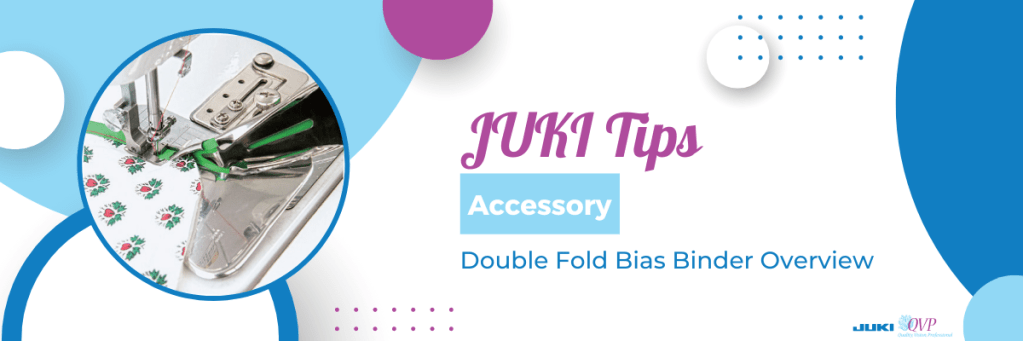
On this JUKI tip, we use the Double Fold Bias Binder and show you how to feed the fabric into the machine with this accessory and create a smooth sewing experience!

Follow along below for a rundown of what Alba covers on today’s JUKI Tip!

Hi, friends my name is Alba and I would like to welcome you to another tips and tricks with JUKI! Today I am talking about the double-fold bias binder and I have two sets in this video; one is a 38-millimeter and one is a 32-millimeter. The one I have on my machine is the wider of the two and I want to show you what exactly is in the package when you open this up.

I am going to open it right in front of you and I am going to pull out the binder itself and it comes with fabric and binding on it. It also comes with a little package with a thumb screw and a foot, and it comes with an instruction sheet. So what I wanted to show you is a little bit of detail, of what is in this, and as I said the one that’s on the machine is a 38-millimeter one, and what that means is how wide the fabric is that is put into the binder and how wide the finished product will come out.

For the 38-millimeter one, I used a one and a half inch strip of fabric, folded it and the completed bias is about 3/8 of an inch. Now what I like about this is you’re going to notice how short that foot is and this is really helpful as you’re sewing because that binder can get really close to the foot and allows for very little movement and of course we have our thumb screws to be able to put this onto the machine. Now what most people get confused with is they’re expecting this portion here to lay flat on the machine but as you can see in the video this accessory rests off of the machine. The thumb screw goes into the screw hole that’s on the bed of the machine, so these are intended for the industrial machines and the machines with solid metal beds, so that they could get screwed directly into the machine and a lot of people do not realize that pivot action that this attachment has.

Now I have two pieces of fabric and both of them have been cut to one and a half inches, and I’m going to show you the struggle that most people have and my tip for feeding the fabric into the machine and getting this to run smoothly. Now most people try to feed the fabric with it in the position right in front of the foot, but if you pivot this, it allows you to better see, getting that fabric in there and just puts you in a much better angle. Now as you’re noticing, I have the wrong side of the fabric facing me. Where most people have an issue is right there and I’m gonna get recommend a stylus, and with that tip, the fabric needs to go underneath its section in the video. Now this is where a lot of people have trouble trying to do that and I’m going to give you my tip for getting that done.

Now let me pull my trusty scissor out and I am going to cut a point into my fabric. By putting a point into that fabric, and you definitely want to use a stiletto, look at how easily that goes right into that fold. And as I pull this out I want to make sure that my fabric is folded, and what I do is I give this a little bit of a finger press. Now when I lift my foot and lift my needle I can move that fabric right underneath the foot and that large thumb screw will allow you to move this right and left so that when you lower your foot. Your needle is just slightly off of that edge to top stitch that edge. Now as I cut this, it was the width of fabric, and I am going to just sew away. Now watch in the video how even at that full speed, how brilliantly and effortlessly that works because this attachment is right up to the foot.

Now I am showing you sewing these pieces shut. I’m going to do a video really soon on putting um this into a quilt sandwich, and doing that mitered corner, but I wanted to show you this finished product and also some of the crafty things that you can do with these strips. You might have noticed my lanyard and I really like fun bright colors so I made my lanyard with the strip, and I happen to have made it so that it can hold my little scissors but also weaving fabric and doing that repeatedly so that you can create your own fabric and your own patterns, how cute would that be as an inset for a waistline? Or for a garment, for a tote bag. I want you to Google and search YouTube videos for fabric weaving to see all of the different things that you could do with that. I want you to stay tuned for another video that I will be doing on mitering corners and using this on quilt fabric.

Thank you for coming and sharing your time with me, what do you want to see next on JUKI tips? Lets us know down below!

JUKI Tip: Changing Your Foot Control Function Settings

Have you learned all the different ways you can use your foot controller on your computerized sewing machine? Check out our tips today to learn all 7 ways you can enjoy sewing with just the tap of your foot!

Follow along below for a rundown of what Alba covers on today’s JUKI Tip!

Today we’re going over the foot pedal and the foot switch function on the foot pedal for your machine. It has two sections to step on, the blue section for sewing, and the heel section or the white section, which on many of our machines can be programmed to do different functions.

The DX-2000 offers options to change the settings on your foot control functions for example as you’ll see demonstrated in this video. This function is normally found on our full-size machines!

To best follow along with today’s video, please refer to the section of the manual where all of this is laid out and that is on page 93! Now, the heel function of the foot pedal has six different parts we’re going to show you, and we’re going to cover what those functions are and how to get them going.

First, tap on the icon that looks like a wrench and a screwdriver; this is where we go into settings to change features on our machine. When you press that your screen comes up with different functions and we are going to tap the arrow until you reach the heel function icon. Next, press OK, and let’s start choosing our functions.

The first function is a feature already placed as a button on your machine, it is the same icon on the machine for reverse; if you select this, it will do reverse stitch. Now, when you press forward on this foot it will always sew as normal, as you tap and press on the back of the foot pedal, you’ll see your reverse stitch begin.

The second function option is a lock stitch. A lock stitch is completed when that needle goes up and down in place locking your stitch so that it doesn’t unravel. This is useful for locking in your projects and securing a quality finish.

The third function is a half stitch. The icon for this function shows as a needle with arrows up and down, and what this will do is it will take a half stitch as you come to the end of your thread. This feature is useful to secure your seam but not lock it if you do not want any build-up of threads you’re going to sew.

The fourth function will have the presser foot lifting and lowering. As you start sewing and touch that heel portion of your foot control it will leave you with the foot up and the needle down and this is really helpful if you were going to do continuous sewing or chain piecing!

The fifth function is the cutting function. The cutting function can be very helpful! When your stitch is done this function will trim your top thread and bottom thread at the same time, saving you the trouble of finding your thread scissors.

The last function is the ability to turn off all extra functions when tapping the back of your foot controller. You can turn them on and off as needed helping you create your projects with ease. Remember, the details of this are on page 93 of the instruction book for the DX series, and offer images you can follow to learn more!

Thank you for joining today’s tip, we hope this helps you create easier the next time you’re working on your machine!

Clean Up with JUKI!

When was the last time you gave your machine some TLC? Today we’re going to go over some general tips on how to keep your sewing machine maintained and ready to sew! If your machine needs a deep cleaning, take it to a nearby sewing machine technician.

Let’s start with the basics: cleaning, oiling, and changing the needle.

External Cleaning

The best place to start cleaning is the outside of your machine. Turn all power off and unplug your machine before removing the needle and presser foot. This is a safety precaution to save you from being pricked.

Grab a microfiber cloth and dampen just a little and get to work! Stay away from using any harsh chemicals on your machine or solvents. We recommend a small amount of dissolved detergent or dish soap if you find a stain that won’t come out.

For those hard-to-reach spaces, we recommend using your craft pipe cleaner. It’s best to do this at a slow pace to avoid unnecessary damage to your machine, especially near a spot with wires. This way, you can avoid bending or wrongly adjusting anything.

Internal Cleaning

Once the outside of your machine is looking clean, let’s move on to the needle plate area. While each machine is different, your manuals will display how to remove your needle plate. If you find yourself without a physical manual, remember JUKI places digital manuals on our websites.

Begin by removing the screws from your needle plate using a T-shape screwdriver. Next, place the screws somewhere safe and secure. We don’t want to lose any!

Once you have removed the needle plate and secured your screws, it’s time to dust! Here we recommend using the brush your machine comes with or grabbing that craft pipe cleaner to remove the lint and dust. If you find any loose threads, use your tweezer to capture those stray strands slowly.

*Never use canned air on your machine. This will cause dirt and lint to be pushed further into your machine rather than clean it.*

Once you’ve dusted the general area, it’s time to focus on your bobbin area. Your first step is to remove the bobbin case and shuttle hook. Once that’s removed, you’ll be able to clean the space behind it where lint and dust fall. Remember to be gentle in the process, your machine has many parts and tricks, and it’s best to go slow and easy when cleaning.

Our best recommendation is to service your machine regularly. A professional sewing machine technician will safely clean out those spots you might have missed and access parts we wouldn’t recommend doing yourself.

Needle Plate & Bobbin Area for DX-4000QVP

Oiling

The first thing to know about oiling is not all machines will need it. The best place to find your answer is in your manual. Remember, if you find yourself with a lost manual, JUKI uploads our machine manuals on our website!

Something to keep in mind is that non-computerized machines, like our TL series, need regular oiling. However, our machines like the DX series are computerized and self-lubricating, so you do not need oil.

We recommend checking out our video here for maintenance and lubrication knowledge for our TL series.

If your machine requires oiling, your JUKI machine will come with a plastic container of sewing machine oil. You can also purchase this from your local sewing machine shops. Remember, your manual is your best friend! Requirements on where and how can be found there when it comes time to oil. We recommend applying one drop of oil to each arrow point shown above for every 4 to 8 hours of sewing. Use machine oil (New Defrix Oil No. 1) or similar supplied with the machine.

Changing the Needle

One of the most important things you can do is change your needle. Needles can dull, get bent, and become damaged, and it’s one of the most significant factors in your machine performance. We recommend changing your needle every 8 hours of usage or starting a new project.

A tip to keep in mind is that the flat side of the needle will usually face away from you on our DX series machines and face towards the right on our TL machines.  Recommend checking your manual. Always confirm that your needle is pushed up and that your screw is tightened to secure the needle in place.

Remember, depending on your project and fabrics is how you choose your needle. You want to make sure you’re using the right one for the job between different types of needles and sizes. This will lower the chances of needle breakage and machine error. Things to consider when choosing your needle are the fabric type, project idea, and thread.

When it comes to maintaining your machines, it’s best to take your time and go slow. If you’re ever in doubt about how to clean your machine, visit us on our JUKI Home Sewing Youtube page here.

You’ll be able to find maintenance videos on many of our machines and more! Don’t forget to stay tuned as we continue to launch new videos on JUKI machines and more.