JUKI Tip: Adjusting The Bobbin Tension On Your Longarm

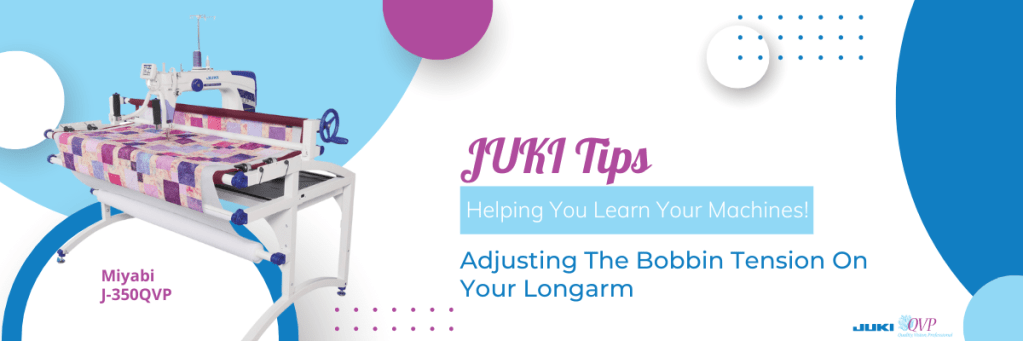
For this month’s JUKI Tip, we’re focusing on adjusting the bobbin tension on your longarm machine like our Miyabi J-350QVP! A common question we hear from sewists and quilters is, “how do I adjust the tension for my bobbin on my longarm?” We’re going to start off today’s JUKI Tip by covering what bobbin tension is, how to get true good tension for your next project, and a tool we think all quilters and sewists can benefit from having in their tool kit!

Follow along below as our JUKI National Account Trainer Alba demonstrates setting the bobbin tension for her Miyabi J-350QVP Longarm machine and how she finds the perfect tension for her project needs.

The first thing we cover is what our bobbin case and bobbin look like. For our JUKI longarm machines, you’ll need an M-Class bobbin and bobbin case. Inside the bobbin case, you’ll find its spring, which prevents backlash as your bobbin turns inside. Always check on your spring when changing bobbins, confirming its blue color to ensure it’s good to go! If you notice the blue haze diminishing, it’s time for your spring to be replaced.

Now it’s important to take care of your bobbin case! Handle with care to ensure that the metal doesn’t receive any bumps or bending from drops. This will affect your tension in the long run and how the bobbin pulls on your thread.

Starting off with a full bobbin, we’ll place the bobbin thread inside the bobbin, ensuring to pull the thread to the right side, before placing the bobbin in the bobbin case and stretching the thread to where the slit is so that it falls right into that tension area. That area is what holds the thread tension when you’re creating. Now the two screws you see on the side can be used to adjust the tension. By turning the screws in 15-minute increments, as opposed to twisting it fully, you’ll be able to adjust your tension slowly to your goal tension number. Remember, lefty loosey and righty tighty!

There are two ways to test your tension. One way to test your tension is by hand. You can do this by setting the bobbin on your palm, making sure to face the bobbin away from you as it normally would in the machine, and then pulling on the thread. You’ll want to make sure you can pull the thread up, slowly lifting it from your palm without the bobbin releasing from the bobbin case. The second way, a technique that offers more precise measurement, is using a tool like the TOWA Guage.

The TOWA Gauge is a tool quilters will love because of the assistance it can offer when you’re trying to get that perfect tension. The goal place our trainer recommends is between 180 and 200. However, her favorite is a little lower at 150. On a longarm, you want your tension to be able to handle multiple layers of batting and fabrics, so you’ll want your top thread and lower thread to meet right in the middle of your batting for good strong tension.

Following along on our youtube video, you’ll notice how inserting the bobbin into the TOWA Gauge is like inserting the bobbin into your longarm machine. Make sure to listen for a click as your setting your bobbin to ensure it’s placed in properly. Next, stretch the thread and run it along the bottom side of the first wheel and up and around to the top; here, you’ll begin to notice the gauge move. As your thread goes into the thread guide and out to the side, pull steadily and even to measure the tension. From here, you’ll be able to decide if you need to adjust the tension number to your preferred goal tension.

Once you’ve finalized your perfect bobbin tension, you can focus on your needle and thread combination. Having the right bobbin, needle, and thread is what will help your projects finish successfully and beautifully, but we’ll cover those combinations soon!

Thank you for joining us in this month’s JUKI Tip, where we focused on how to adjust the bobbin tension on your longarm machine. What JUKI Tip do you want to see next? Let us know in the comments below!
5 Ways to Personalize Your Projects

As creators, we love being inspired by other sewist and quilters, but how do we take their inspiration and personalize it? Today we will discuss five ways to personalize your sewing and quilting projects. From adding lettering to printing on designs, there are so many ways we can find a project and turn it into our style. So follow along and check out what machines and accessories we recommend for your personalization touches.

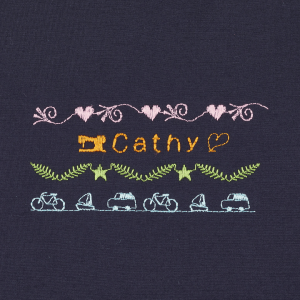
Adding Lettering

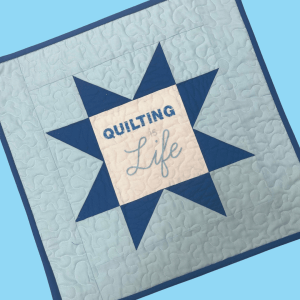
Whether you’re inspired to create a tote bag, or a sweater, adding lettering to your projects can be just the touch of personalization you need! Add your initials with your partners on a sleeve to create the perfect valentines gift, place your child’s name on their new school bag, or gift a quilt with a quote to your loved one using the lettering feature on your creations.

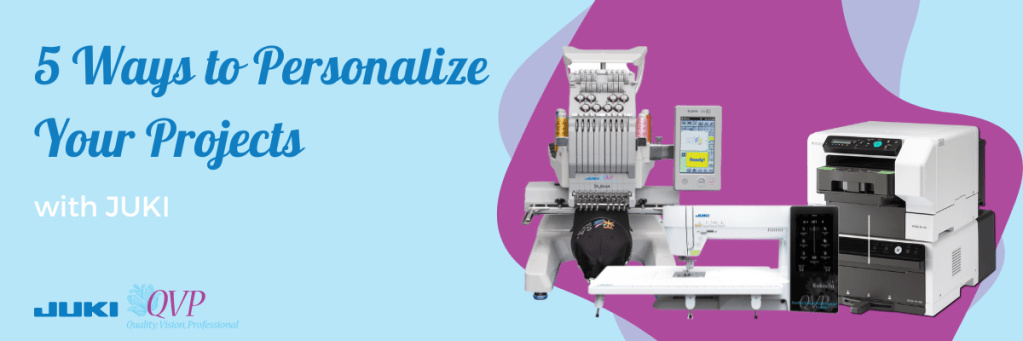
To add this personalization technique, you can use an electric computerized sewing machine that offers lettering, like the Kokochi DX-4000QVP! An electronic computerized sewing machine like the DX-4000QVP offers lettering stitch choices, ranging in different fonts, that will allow you to quickly and easily stitch in your child’s name, favorite quote, or number one sports team name!

Adding lettering is an easy way to personalize your next project and can be done with just a tap of your finger and a stitch!

Adding Embroidery Designs

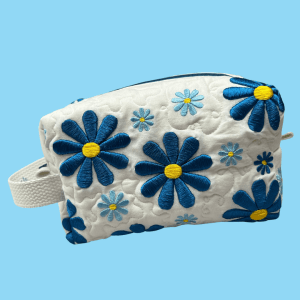
Using a specialized embroidery machine, you can start adding your designs and bring texture to your projects by adding a touch of your personality! For example, add a cool design to sneakers, pet collars, or even a child’s teddy bear to create a project representing you or the gift receiver.

A machine like the JUKI/Tajima Sai 8 Needle Embroidery Machine is an example of a machine that can offer this feature! With 8 different color options, you can create beautiful flowers, animals, and a scenic view from your last hike. Art is limitless with what you can create on an embroidery machine. Adding embroidery can be an exciting art form when creating personalized projects!

Want to try your hand at embroidering and creating a makeup bag? Learn how to create this makeup bag with our JUKI Ambassador Nicole Moore here!

Designing Your Fabric

Have you found yourself wanting a specific fabric design? Been drawing some designs of your own? Then take the leap and design your own fabric! With a machine like a Direct-To-Garment printer, the options in patterns and designs for your projects are now endless, thanks to the ability to design your own fabrics right from your studio.

The RICOH Ri 100 can help you print your art designs and patterns onto fabric easily and quickly. From canvas fabrics for your tote bags to cotton for your memory quilts, enjoy the freedom of designing and creating anything for your imagination, and enjoy a material that no one else would have!

Try your hand at printing your own fabric with this east mini quilt project! Learn how to create your own with our JUKI Ambassador Nicole Moore here!

Adding in Photos

Whether it’s a family photo or a memory from your favorite trip with friends, adding a memory photo to a project like a t-shirt or a quilt is a great way to personalize your projects! Whether you’re embroidering designs with free motion quilting, using a Direct-To-Garment printer, or using an embroidery machine, there are limitless ways you can get to designing and including your photos in your projects.

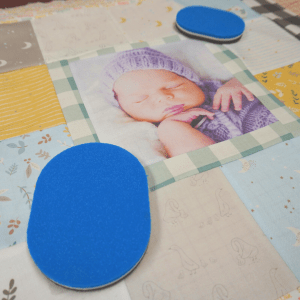
Our favorite projects are memory quilts users create with photos! From sweet newborn gifts to anniversaries and holidays, a quilt created with personalized love is an excellent idea for your next gift project! Using a machine like our Direct-To-Garment printer, the RICOH Ri 100 can easily print and place your photos directly onto the fabric you’re creating, letting you put your focus on your quilt block designs.

Want to create your own memory quilt like the one shown for your loved one? Follow along here to learn more here!

Creating a Set

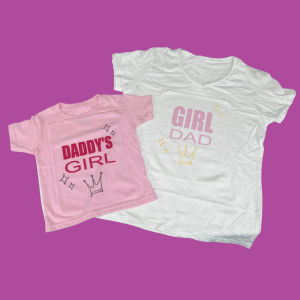
One of the best things about personalization is the freedom to be creative in what we embroider and print on. Personalize your next gift by creating a matching set! Whether it’s a set of make-up bags for traveling, or a matching set of t-shirts for the father and daughter duo, sets can be a fun gift that allows you to try different project ideas.

One of the best ways to create sets is to intermix your work! Print on your fabric, embroider your design and sew it all together to create something unique and different. Whether your project is small, like a glasses case, or large, like a king quilt, adding these touches of personalization will bring the whole idea together!

So the next time you create a project, add your name, embroider a design, or print on a pattern and show your personality when showing off your project!

Want to try your hand at creating a matching set? Check out our Daddy and Daughter duo set project here!

Want to personalize your next project? Then, visit us here today to find your nearest JUKI dealer!

JUKI Tip: Using The Micro-Lift on the TL Series

For this month’s JUKI Tip, we’re focusing on the micro-lifter feature that can be found on your TL series machines! Now, a common question we get is, “what is different about the Micro-lift feature from the presser foot pressure?” To show the difference, we’re going to use the TL-18QVP because it has two different locations for each feature.

Now the presser foot pressure, as it sounds, is the amount of pressure the foot puts on the fabric you’re sewing. For example, if you’re moving your project, the presser foot pressure is what will help you keep that nice straight seam. With the Micro-lift feature, your presser foot pressure will stay the same, but the height of the foot will change. Raised above the feed dogs, your foot will now have space to create using multiple layers of fabric, thick fabrics, complete binding easier, work on handbags, and so much more.

Our favorite part is not needing to adjust the presser foot pressure as often when using the Micro-lift feature, helping your project process become more simple.

As you watch the video, you’ll be able to follow along as our National Account Trainer Alba demonstrates how the Micro-lift feature looks when in use, and how easily the fabric you’re working on will go through. From 8 layers of denim to 15 layers of denim, you’re able to see how the fabric smoothly glides through; the needle easily sewing through the material.

We hope this video encourages you to try your hand at the Micro-lift feature on your machine and that it helps you create beautiful projects with quality style! What JUKI Tip are you hoping to see next? Let us know in the comments below!
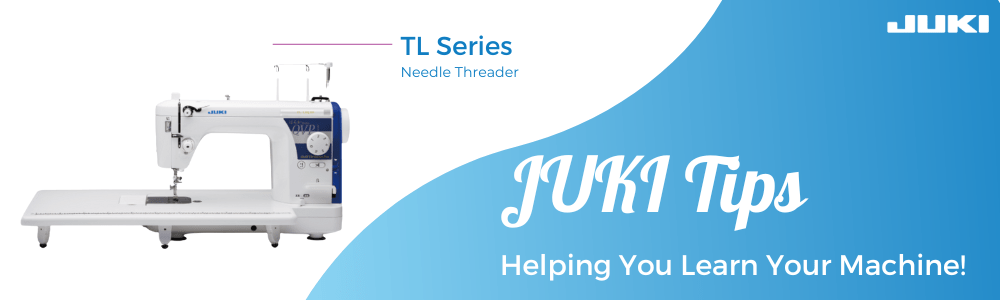
JUKI Tip: Working with Your TL Needle Threader

At JUKI we know how important it is to know your machine’s features and how to use them, so starting this year at JUKI we’ll be sharing monthly tips for creating on, and using, your beloved JUKI sewing and quilting machines! This month we’ll be focusing on the TL Series and its Automatic Needle Threader. Showcasing each step, and how the feature works, follow along below to view our Tip Video and breakdown.

Needle Up/Down Feature

The first step is knowing where your Needle Up/Down button is, and when to use it. Now the most important step to using your needle threader is, making sure the foot is in the down position (engaging the tension) and using your Needle Up/Down button to lower and raise the needle.

You’re going to start with having the needle in the highest position, before using your needle threader, so your machine can thread your needle.

Check out time stamp 1:42 to learn where you can find your Needle Up/Down button.

Threading Your Needle

Stopping right before the eye of the needle, we’ll be using our Needle Threader today to get our machine ready to create.

To start, your thread should be at the point right before needle-eye entry.

Next, we’re going to pull our thread off to the side and lower our mechanism all the way down. Now grab your thread and go behind that metal groove on the needle threader, and into the two grooves on the white piece of the mechanism, while holding your thread off to the side. Check out the time stamp 4:00 in our video about for an example of this section.

Now, when we raise the mechanism, you’ll see a loop formed with your thread on your needle. Once you see the loop, pull the thread carefully through the needle and to the right, completing your needle threading!

To learn more about the TL series visit our JUKI Home Sewing YouTube page here, or visit your local JUKI Dealer here.

Have questions about your JUKI machine? Let us know down below! We look forward to creating more JUKI Tips to help you bring your projects to life.

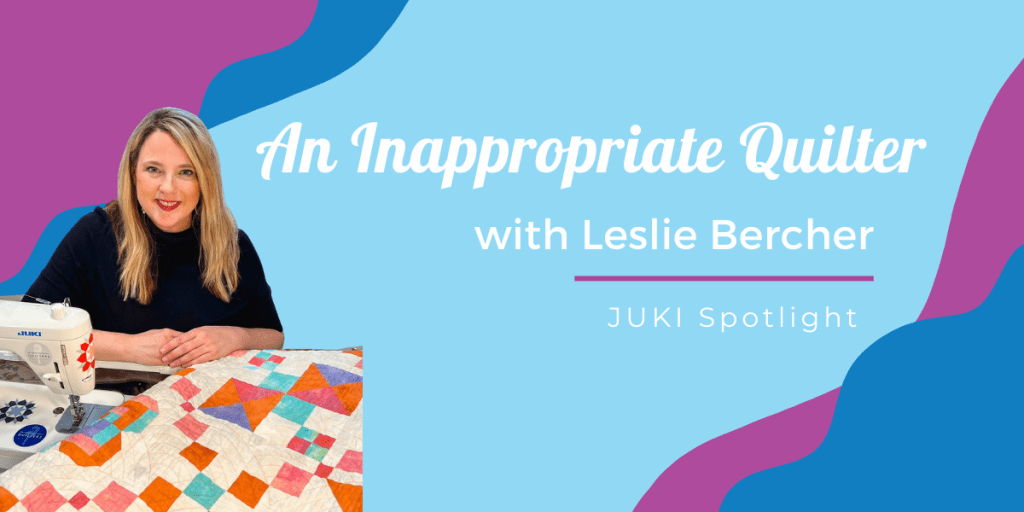
JUKI Spotlight: An Inappropriate Quilter with Leslie Bercher

Known for creating beautiful quilts, sharing tips and tricks for your sewing rooms, and her quilting podcast with co-host Rochelle Rice, we’re excited to spotlight Leslie Bercher, Quilter and podcast host for Inappropriate Quilters! Joining us for this month’s spotlight, we got to interview Leslie about her journey in quilting, the podcast’s beginning with co-host Rochelle, and how she created her brand.

It all started with Leslie’s grandmother, Helen. Helen was a member of a church that held Auxiliary Meetings where other members would quilt, crochet, and embroider. It took Leslie several years to watch her grandmother attend these meetings and see her create beautiful projects before picking up the hobby. So it was 2018 when Leslie, with two of her best friends, decided to take a class called ‘Quilt 101’.

“My first quilt was a log cabin, and I made two immediately. That was the beginning, and I haven’t looked back.”

Leslie began sharing her work online, finding a passion for creating and taking the time to build these quilts and designs. It was after a friend recommended she create a profile on social media, explaining she was missing out by not joining the online community when she opened her account. Opening herself up to the idea, she began posting and sharing her projects, excited to see how many beautiful quilters were out there in the world.

It was online that Leslie found a supportive community in her projects and offered her the opportunity to network and build relationships with new people! Consistently supporting one another in their ideas, and encouraging those who have lost their “sew-jo,” as Leslie says, has made the community, unlike any other group she’s been a part of.

This community has also been the inspiration for countless projects she’s created, inspired by other creators on social media. While not a modern quilter, she finds inspiration in all their designs picking from their color selections, patterns, and quilting textures. She also focuses on who she is creating, letting that drive much of the inspiration.

At one of these quilt retreats with the quilting community, she met Rochelle, someone who, according to Leslie, “has never met a stranger.” Leslie and Rochelle were placed in the same group, and their group’s theme was chickens! With their organized and over-the-top decorations, they couldn’t resist having a group mascot, Leon, the rubber chicken.

One day, during the retreat, Leon went missing! Leslie convinced Rochelle was to blame for the Rubber Duck disappearance, and she took it upon herself to ‘borrow’ Rochelle’s foot controller from her machine when she wasn’t looking. The joke would fall back on Leslie when Rochelle returned to the retreat the next day after a nice early night in, unaware her controller had been taken in the first place! They were fast friends after that, bonding over jokes and laughter.

 A couple of years later, the podcast topic would come up between the two friends. During a dream quilt vacation, a sewing retreat where two of their favorites, Camille Roskelley and Angela Walters, would attend, they were having breakfast when the idea popped into Leslie’s head.

With only an idea and some research, Rochelle purchased all the equipment while on their retreat and had it shipped to her home for when they arrived back in town. Excited about their new project, there was only one thing missing, a name! But, as their friends joined in on the conversation, one name stuck out. Walking away from their breakfast table, their friend Angela turned around and offered up “Inappropriate Quilters,” the perfect name for the inappropriate duo!

“Angela was getting up from the table and casually said, ‘oh, I know what you should name it. Inappropriate Quilters.’ We looked at each other and said, “that’s it!”

From there, the show project was on! Weekly episodes, released on Saturdays, became the norm where two quilting friends could join together to discuss life and quilting. With no script in hand, the two friends meet at Leslie’s studio weekly to record before she finishes editing and schedules the episodes Saturday morning. Finding their way into other quilters’ studios through their speakers, their show focuses on just two friends who love quilting, allowing listeners to feel like they have friends in the room with them when they’re creating.

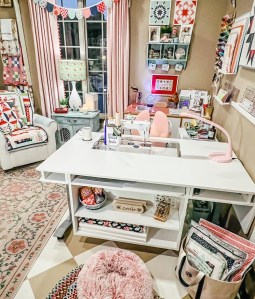
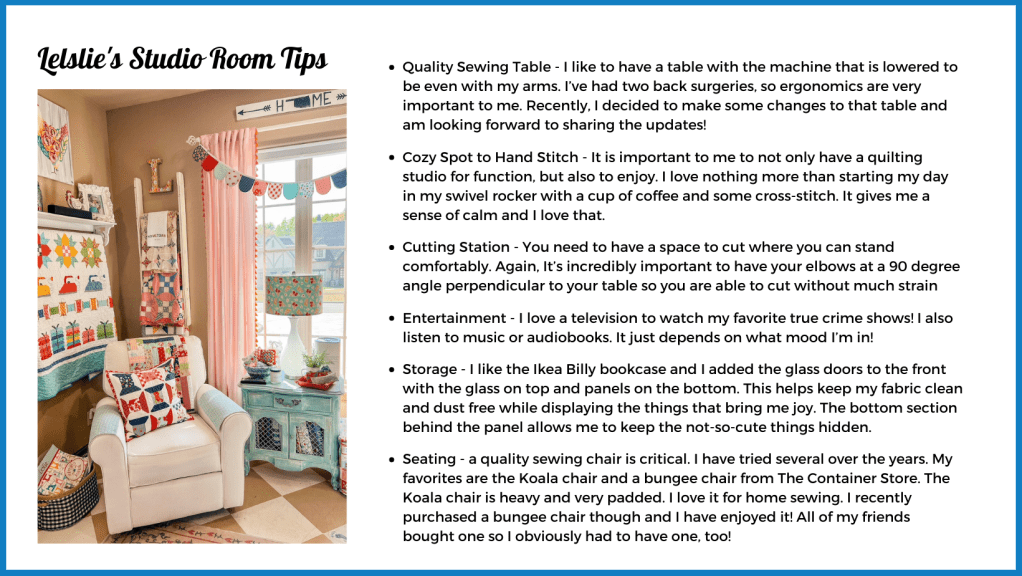
One topic Leslie loves to cover is the process of creating and organizing your studio space. As quilters and sewists know, having a space that encourages creativity and allows you to move and build your projects is important! As an advocate for ‘Function and Beauty,’ we asked Leslie what recommendations she can offer to those building their studio space today.

“You have to start with function. But if it isn’t cute, it better have a very good reason to take up your space!”

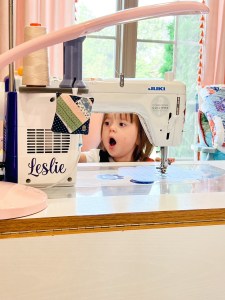
What else can you find in Leslie’s studio? Her JUKI! With her Haruka TL-18QVP, named Camille after Camille Roskelley, Leslie has been able to create beautiful quilts and projects she loves. With 95% of her projects involving straight-stitch, she chose a machine that fit her needs. Her top three features at the time were: consistent straight stitch, an automatic thread cutter, and speed! Her best recommendation to sewists and quilters looking for a new machine is to focus on what features are important to you, figure out what type of stitches you plan to create with, the speed, and visit your local dealer! A local dealer can listen to everything you may want and offer machine recommendations and test-sewing.

Leslie’s quilting has opened up a community for her, allowing her to be creative, meet new people, and enjoy her hobby! As she’s transitioned to a content creator and business owner, we asked what advice she’d offer to someone trying to build their brand. “There are so many little things that you didn’t plan. Be gracious with yourself in the process.” Setting up the government business aspects of a shop, like tax ID, sales taxes, and even finding a partner, can be challenging, but the final product is worth it when you love what you do!

We’re so excited to continue seeing Leslies’ brand and content grow, especially with possible plans of opening a YouTube page for creators to join! Listening to feedback from the community she’s created is vital, and she trusts them to lead her toward new and exciting project ventures. So even with her reservations about being on camera, you can expect Leslie to meet her community in the middle and find a way to join the video world!

From quilting to running a podcast, we had a great time getting to know Leslie and going behind the scenes for her projects. If you’ve enjoyed getting to know Leslie and want to keep up with her and Rochelle’s podcast and future quilt projects, join us in following her socials and websites below!

Blog: read here!

Instagram: follow here!

Linktree: Find Leslies channels here!

YouTube: watch here!

Podcast: Inappropriate Quilters – available where you listen to podcasts

Inappropriate Quilters Shop: shop here!