Quilting Your Memories with JUKI

Today, we’re going to talk about memory quilts and how they’re more than just cozy blankets but tangible pieces of our personal histories! Transforming old T-shirts, jerseys, and other sentimental clothing into quilts creates unique keepsakes that celebrate special moments and memories. In this guide, we’ll discuss the process of crafting a memory quilt, from gathering materials to the final stitches, and how to use the advanced features of JUKI sewing machines to bring your vision to life.

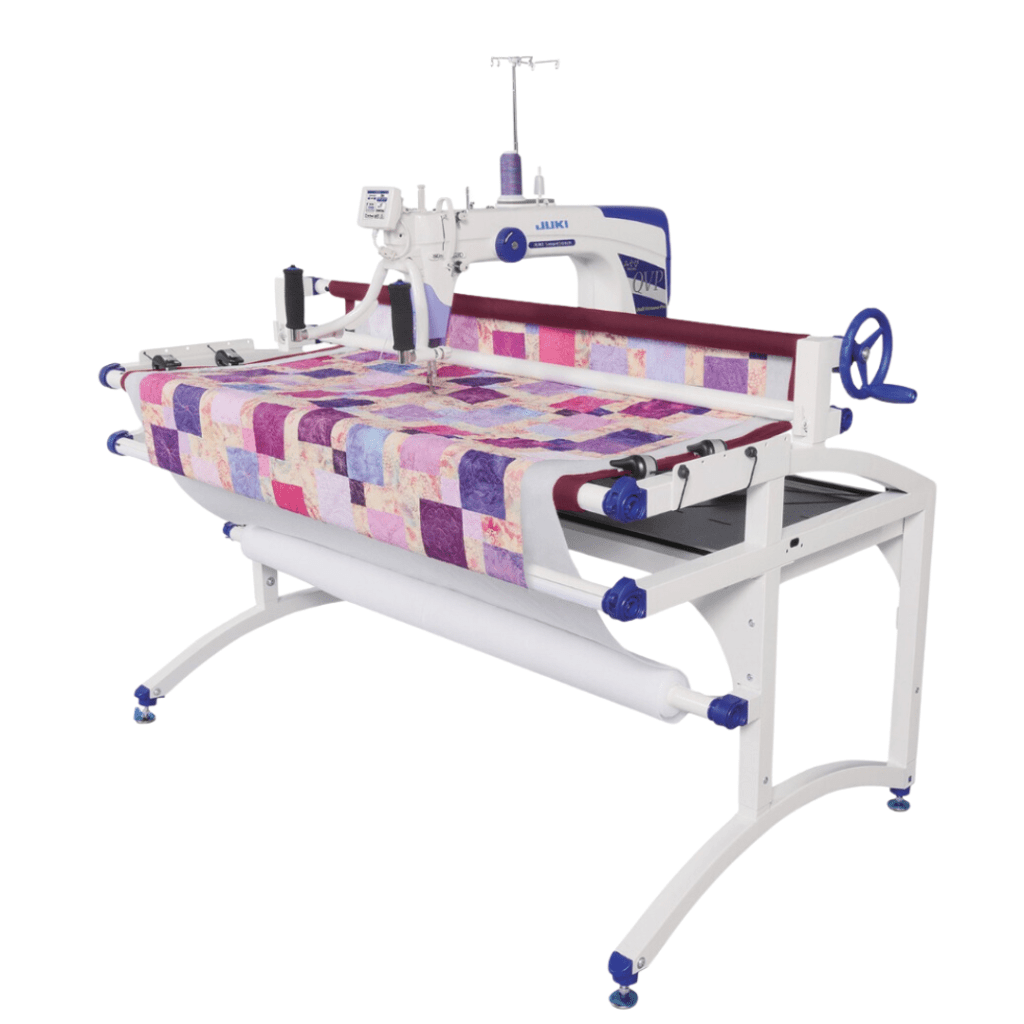
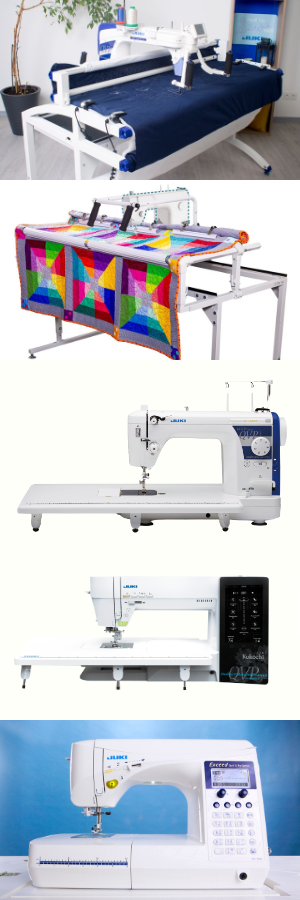
Many JUKI machines can help you create the perfect memory quilt, so here are a few of our favorites! For larger machine space options, the Miyabi J-350QVP offers a spacious work area up to a king quilt and precision stitching capabilities, which are ideal for handling large quilt tops and intricate designs. The Q-Zone Hoop Frame provides the stability and ease needed for quilting. It’s compatible with multiple JUKI machines and ensures your finished quilt will be beautiful and durable.

For smaller workspaces, the TL-18QVP offers the strength of our JUKI Industrial machines, with features like the automatic needle threader and float function for quilting. We also have computerized sewing machines like the F series and DX QVP series that offer various stitch options for decorative stitching and free-motion quilting.

Step 1: The Memories

Let’s start planning your memory quilt by deciding what pieces of clothing items have sentimental value! Think of your T-shirts from memorable events or team shirts from sports teams. Give these items a quick wash and check they’re in good condition, like stains or excessive wear.

If any pieces are damaged but meaningful, consider using the undamaged portions. Pay attention to the fabric type and weight; it will affect how you prepare and stabilize the fabrics. Understanding the differences will help you plan the quilt layout and choose the right material for your project.

Keep in mind the fabrics you select. You can aim to coordinate solids, patterns, or themed prints or make a theme like sports, traveling, or interests. Consider using neutral tones like white or black to frame and balance more vibrant pieces. At this stage, consider the backing fabric, ensuring it complements the front and is durable enough for regular use. Cotton is popular for its softness, but flannel or themed prints can add a personal touch. These additional fabrics will help unify the overall design and enhance the quilt’s aesthetic appeal.

2. Preparing the Clothing

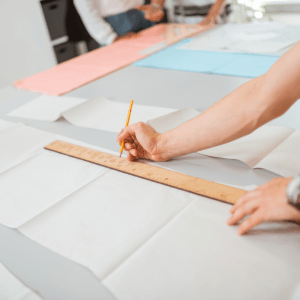
Cutting: Start by laying your clothing items flat on a cutting mat; this will help ensure accuracy and consistency in your cuts. Using a rotary cutter, carefully cut the clothing into uniform squares or rectangles; 12″12″ is a common and manageable size for quilt blocks if you’re unsure where to start.

If your clothing items feature logos, graphics, or designs you want to highlight, center them within your cut pieces. Using a clear acrylic ruler to guide your cuts is also helpful, ensuring straight edges and precise measurements.

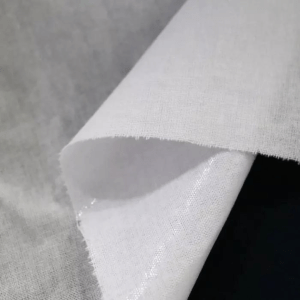
Stabilizing: Stretchy fabrics like those found in T-shirts require extra care to ensure they don’t warp or lose shape during quilting. To stabilize, apply fusible interfacing to the back of each piece before cutting it to size.

Fusible interfacing is a lightweight material that, when ironed onto the fabric, provides additional structure and reduces stretch. Once stabilized, these pieces will be easier to work with, allowing for more precise cutting and sewing. This will result in a quilt that lies flat and retains its shape over time.

3. Designing the Quilt Layout

Plan Your Layout: We recommend starting your memory quilt by arranging your pieces on a flat surface, like a large table or the floor, and experimenting with different quilt layouts. This allows you to visualize how the colors, patterns, and clothing designs will work together.

Balance the colors and the placement of significant items, like logos or graphics, to ensure they are well spaced out across the quilt. This step is key to achieving a harmonious and aesthetically pleasing design!
Create a Mock-Up: Once you’ve settled on a layout you like, consider creating a mock-up to finalize your design. You can use design software like Adobe Illustrator or quilt-specific programs to digitally recreate your layout, allowing for easy adjustments and precise planning.

If you prefer a hands-on approach, sketch your layout on paper, noting the position of each piece! This mock-up will be a valuable reference during the assembly process, ensuring that your final quilt matches your envisioned design. It also helps you spot any potential issues with spacing or alignment before you start sewing.

4. Assembling the Quilt Top

Sewing Pieces Together: Begin by sewing your fabric pieces into individual rows. Align the edges carefully as you sew to ensure even rows and minimize fabric shifting. Once your rows are complete, join them, matching the seams where they meet.

Pressing Seams: After sewing each row, pressing the seams is important to create a smooth quilt top. Depending on your preference and the thickness of the fabric, you can either press the seams open or to one side.

Pressing seams open reduces bulk and helps the quilt top lie flatter, especially if multiple seams intersect. Use a hot iron and apply firm pressure to set the seams, ensuring that the fabric lies evenly and without puckering. Properly pressed seams will make the quilting process easier and contribute to the overall polished appearance of your finished quilt.

5. Adding Batting and Backing
Choose Batting: Find a batting material that complements your quilt’s desired thickness, warmth, and overall feel. Batting comes in various materials, such as cotton, polyester, wool, or blends, offering different loft levels and insulation.

When making your choice, consider how you intend to use the quilt—whether it’s for warmth, display, or as a lightweight throw. Cotton batting is popular for its breathability and smooth finish, while polyester offers more loft and is lightweight!

Cut Backing Fabric: Once you’ve chosen your batting, it’s time to prepare the backing fabric. Cut the backing fabric slightly larger than your quilt top, typically adding a few extra inches on all sides. This extra fabric allows for any shifting during the quilting process and ensures full coverage. Lay the backing fabric flat and smooth out any wrinkles before cutting to ensure a precise fit.

6. Quilting with JUKI

Layering: Next, lay out the quilt layers on a flat surface. Position the backing fabric with the wrong side facing up, followed by the batting layer, and finally, the quilt top with the right side facing up. Carefully smooth out any wrinkles or folds in each layer to ensure a smooth surface.

Once aligned, baste the layers together using your preferred methods, such as safety pins, basting spray, or hand stitches. This step secures the layers, preventing them from shifting during quilting.

Quilting: With your quilt layers basted together, you’re ready to begin quilting! Choose a quilting method that complements your design, such as straight-line quilting for a clean, modern look or free-motion quilting for more intricate and personalized patterns.

Take your time to work evenly across the quilt, starting from the center and moving outward to avoid any puckering or uneven tension. Depending on the design, you should stitch in the ditch (along the seams) or create an all-over pattern that adds texture and visual interest.

7. Binding the Quilt

Trim Excess: Once the quilting is complete, trim the excess batting and backing fabric to match the edges of your quilt top. Use a rotary cutter and ruler to achieve straight, clean edges, ensuring the quilt’s perimeter is uniform.
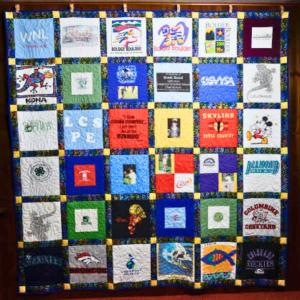
Attach Binding: Attach the binding to the edges to finish your quilt. Binding seals the raw edges and adds a polished frame to your quilt! Start by sewing the binding to the front of the quilt, then fold it over to the back and hand-stitch or machine-stitch it in place. Take care to miter the corners for a clean, professional look.

8. Finishing Touches

Final Press: After attaching the binding, give your quilt a final press to smooth out any wrinkles and set the seams. Be sure to press both the front and back of the quilt, paying extra attention to the binding edges for a neat finish!

Creating a memory quilt is a heartfelt way to preserve and celebrate cherished moments through fabric. You can craft a beautiful quilt that tells a personal story by carefully selecting your materials, preparing your clothing, and following each step from layering to finishing.

For the perfect quilting machine to bring your projects to life, be sure to check out JUKIQuilting.com to find the right fit for your needs. Additionally, explore our JUKIHomeSewing YouTube page for inspiring projects and helpful tutorials. Take advantage of our detailed memory quilt project guide at this link to help you get started on your own special creation! Happy Sewing!
JUKI Tips: Celebrating National Quilting Month

As March unfolds, we at JUKI are thrilled to join hands with fellow quilting enthusiasts worldwide to celebrate National Quilting Month!
In honor of this special month, we’ve curated five invaluable tips straight from the Trainers at JUKI. Whether you’re a seasoned quilter or just beginning your journey into this beloved art form, these tips are designed to elevate your quilting experience to new heights. From learning the art of free-motion quilting to optimizing the performance of your long-arm machine, we’ve got you covered.

So, gather your fabrics, thread your needles, and prepare to embark on a quilting adventure like no other. Let’s dive into these expert tips and unleash the full potential of your quilting projects with JUKI!

In our first video tutorial, we dive into the world of quilting excellence with JUKI! In this demonstration, we unveil how to master the art of advancing your quilt on the JUKI Miyabi Long-arm machine while using the innovative QTC 5 program.

We’ll guide you through the steps to seamlessly progress your quilt, ensuring smooth transitions and impeccable results with every stitch. Whether you’re a seasoned quilter seeking optimization or a beginner eager to learn, this tutorial is your gateway to unlocking the full potential of your quilting projects.

In our next tip, we’ll explore an essential technique for unleashing your creativity: transitioning your TL Sewing machine into a free-motion quilting powerhouse!

With this tip, we’ll guide you step-by-step through the process of unlocking the potential of your TL Sewing machine, allowing you to embrace the freedom of free-motion quilting. Whether you’re a novice eager to explore new techniques or an experienced quilter looking to expand your repertoire, this tutorial will equip you with the skills and confidence to take your quilting to new heights.

In our next tip, we delve into a game-changing tip for maximizing your quilting potential: getting creative with our fabric clamps. With this technique, we’ll show you how to utilize every inch of fabric available on your long-arm machine, ensuring efficient use of materials and minimizing waste.

Whether you’re working on a large-scale project or a smaller piece, fabric clamps provide stability and control, allowing you to quilt with precision and ease.

Next up, we’re going to share a transformative tip for expanding the capabilities of your DX Sewing machine: transitioning to free-motion quilting mode. In this demonstration, we’ll walk you through the simple steps to unleash the potential of your DX Sewing machine, allowing you to explore the artistry of free-motion quilting with confidence.

Whether you’re a seasoned quilter seeking to push the boundaries of your craft or a newcomer eager to experiment with new techniques, this tutorial is your guide to unlocking the creativity within.

In our final tip for National Quilting Month, we’re diving into a crucial aspect of quilting success: JUKI bobbins. Watch as we explore the importance of identifying the right bobbin for your sewing machine and the impact it has on your quilting projects. In this video, we’ll guide you through the process of selecting the perfect bobbin for your machine, ensuring optimal performance and stitch quality.

Whether you’re quilting intricate designs or piecing together fabrics, having the right bobbin is essential for achieving professional results!

As we celebrate National Quilting Month, we hope you’ve enjoyed exploring five invaluable tips to elevate your quilting experience with JUKI! From mastering the art of advancing your quilt seamlessly on the JUKI Miyabi Long-arm machine using the QTC 5 program, to embracing the freedom of free-motion quilting and maximizing your fabric usage with fabric clamps, we’ve covered essential techniques to enhance your craft. We’ve also delved into the importance of selecting the right bobbin for your sewing machine, highlighting its impact on the quality of your quilting projects.

Thank you for joining us on this enriching journey, and we look forward to sharing more quilting tips with you in the future. Happy quilting!

Exploring the JUKI Miyabi: A Quilter’s Dream

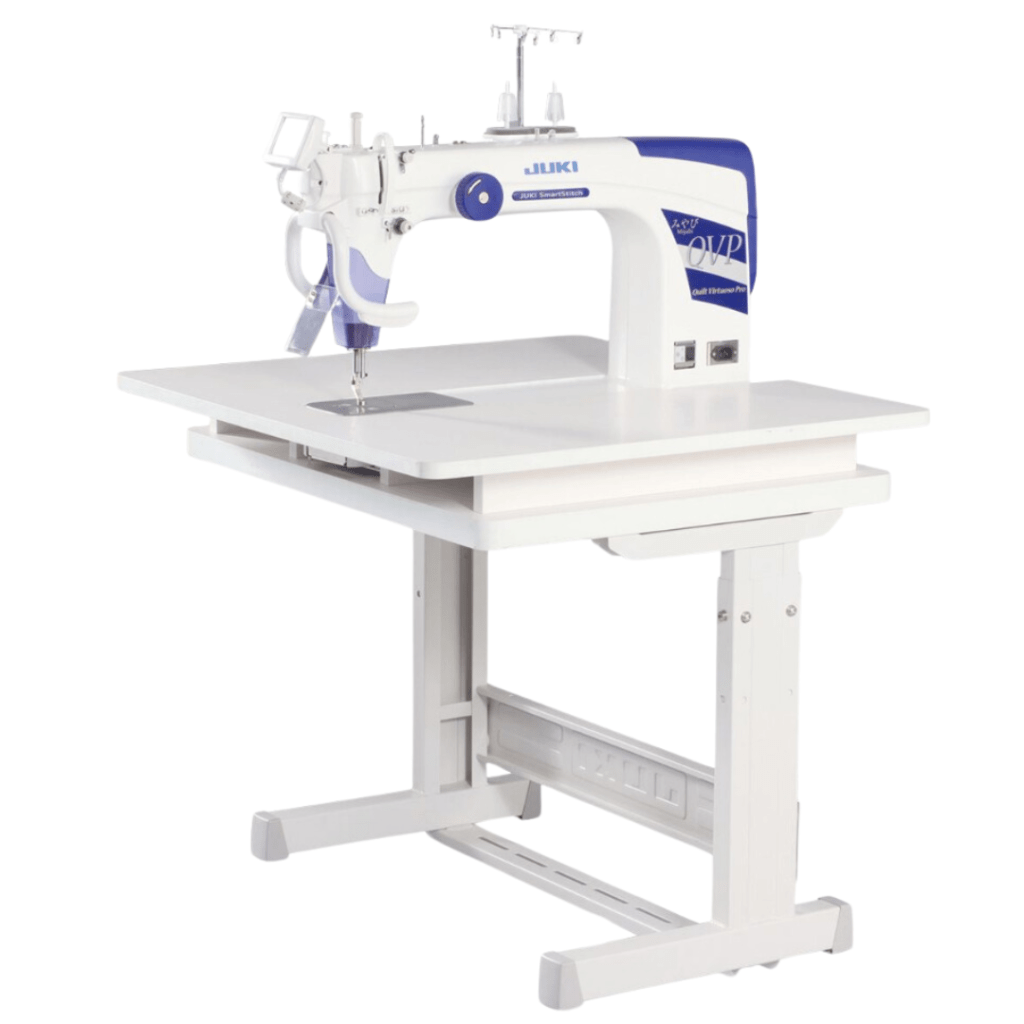
Welcome to our National Quilting Month celebration! Quilting enthusiasts rejoice as we dive into the vibrant world of fabric artistry. At the heart of this creative journey lies the JUKI Miyabi J-350QVP, a long-arm quilting machine that transcends mere functionality—a portal to endless possibilities. With its spacious 18-inch horizontal throat space and 10-inch height, the Miyabi provides ample room for your quilting masterpieces to unfold.

Imagine effortlessly crafting king-size quilts or personalizing couch covers with precision, thanks to JUKI’s SmartStitch technology. But the magic doesn’t stop there; when paired with Quilter’s Creative Touch 5, this machine becomes a sanctuary for artistic expression, catering to both seasoned quilters and newcomers alike.

Join us as we unravel the enchantment of the Miyabi J-350QVP and how it transforms quilting dreams into breathtaking realities. Let’s embark on this journey together, where every stitch tells a story of creativity, passion, and the timeless art of quilting.

JUKI SmartStitch stitch regulator system

Unveiling Miyabi: Crafted for Perfection

Named after the Japanese word for elegance, the Miyabi J-350QVP seamlessly integrates JUKI’s heritage with cutting-edge technology. Central to its allure is the JUKI SmartStitch stitch regulator system, ensuring impeccable stitch lengths regardless of the complexity of your design.

At the heart of its capabilities lies an expansive 18 inches of horizontal throat space and a remarkable 10-inch height, setting it apart from its counterparts. This spacious setup allows quilters to explore expansive designs without constraints, a true delight for those working on king-size quilts or even crafting custom couch covers.

Versatility in Functionality

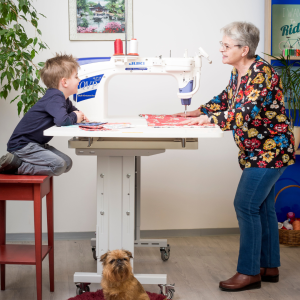
One of the standout features of the Miyabi J-350QVP is its adaptability. It seamlessly transitions from a sit-down configuration (33″ x 33″) to varying frame lengths ranging from 5 to 12 feet, catering to individual preferences and project demands. This adaptability, coupled with a user-friendly interface, extends to its compatibility with Quilter’s Creative Touch (QTC), unlocking a world of possibilities for quilting enthusiasts.

Versatility in a quilting machine isn’t just an added bonus; it’s an absolute game-changer! Whether tackling a small, intricate piece or embarking on a grand, sprawling quilt, this adaptability is a lifesaver. It’s like having multiple machines in one, all at your fingertips.

Miyabi J-350QVP Sit-Down
Miyabi J-350QVP Stand-Up

Why does this matter in the world of quilting? Well, creativity doesn’t fit a one-size-fits-all mold. Quilters are artists; just like artists, they need the freedom to explore, experiment, and create without limitations. The Miyabi’s adaptability offers precisely that. It’s the canvas that adjusts to your vision, whether you’re working in a cozy corner or have a spacious studio. When coupled with Quilter’s Creative Touch, it’s not just about space; it’s about the freedom to design, experiment, and bring intricate patterns or expansive quilts with the same machine to life. This flexibility isn’t just a convenience; it’s the key to unlocking boundless creativity in quilting.

The Power of Quilter’s Creative Touch 5

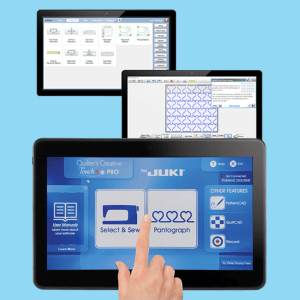
The marriage of the Miyabi J-350QVP with Quilter’s Creative Touch 5 software elevates the quilting experience to new heights. Whether driven by hand or utilizing the software’s capabilities, the Miyabi J-350QVP becomes an artist’s canvas.

For beginners, it’s the ultimate learning companion. The software’s intuitive interface facilitates easy pattern sizing, rotating, and flipping, making the initial steps of quilting feel like second nature. Imagine exploring over 220 pre-existing designs or venturing into creating your own, all with the assurance of precise and automated quilting. The inForm feature is your personal tutor, offering built-in tutorials and tips, transforming your learning curve into a smooth, enjoyable journey.

Now, for the experienced quilters, this software elevates your craft to new heights. The Pro features like PatternCAD™ and QultCAD™ enable you to become a digital architect, designing intricate patterns and entire quilt layouts with finesse. Ever thought of turning your free-motion quilting into reusable patterns? With Quilter’s Creative Touch 5, it’s not just a thought—it’s a reality. And that’s just the beginning.

The program’s goal is to nurture beginners’ budding creativity and amplify seasoned quilters’ expertise, making every quilting journey an enriching and fulfilling experience.

Gold Card Access: Elevating Creativity

For those eager to explore every facet of Quilter’s Creative Touch 5, the Gold Card Access opens doors to an array of exclusive features. Borders and Corners™, Virtual Longarm™, Font Stitcher™, and Fabric Compensation are among the many advanced features offered, empowering users to enhance their quilting prowess.

Let’s Talk Features

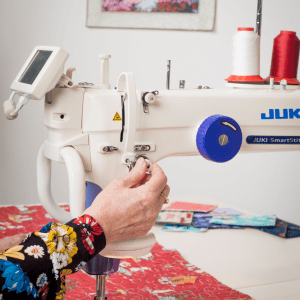
At its core lies the JUKI SmartStitch: Stitch Regulator System (JSS), a technological marvel that ensures impeccable stitching regardless of your speed! The image sensors carefully track movement, guaranteeing flawless stitch lengths as you quilt away, maintaining accuracy at every turn and curve of your creative design.

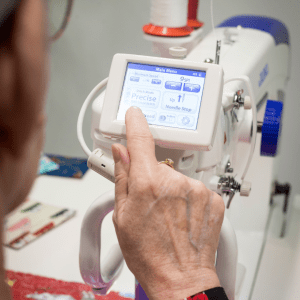
The large color LCD touch screen serves as your command center, providing a seamless interface to control various settings—from stitch regulator modes and LED light configurations to speed control and automatic/manual thread trimming—putting the reins of your quilting journey in your capable hands.

But that’s just the beginning! This powerhouse boasts various features like adjustable front handlebars for personalized comfort, push-button handlebar controls for effortless maneuverability, and an automatic needle positioner for precise stitching placement. The laser guide light aids in following patterns seamlessly, while the Direct Drive Technology ensures smooth, efficient operation with minimal maintenance.

Add to that the solid steel heavy-duty frame, multiple stitching modes, directional LED lighting, and the convenience of an optional rear handlebar—the J-350QVP Miyabi is a quilting dream come true! With its thread cutter system and the option for rear handlebars for pantographs, this machine doesn’t just promise efficiency; it delivers a flawless quilting experience, marking a new era in crafting perfection.

The Miyabi J-350QVP is not just a machine; it embodies tradition meeting innovation. Its technology, space, and precision integration foster an environment where crafting king-size quilts or bringing intricate designs to life becomes a seamless, enjoyable experience. With its impeccable stitching, adaptability, and robust functionalities of Quilter’s Creative Touch 5, the Miyabi J-350QVP is a testament to JUKI’s commitment to empowering quilters worldwide.

As National Quilting Month unfolds, we celebrate the vibrant world of quilting, a time-honored craft that unites enthusiasts of all levels. It’s a month to revel in the joy of creativity, where every stitch tells a story of passion and artistry. Whether we’re quilting veterans or newcomers, we’re united by our love for fabric and its endless possibilities! Let’s embrace this month as an opportunity to explore new techniques, share our experiences, and inspire one another to create something beautiful. Here’s to a month filled with laughter, learning, and the joy of quilting!