Efficient Stitches: Sewing Room Organization Tips

A well-organized sewing room or dedicated sewing space can be the key to a productive and enjoyable sewing experience. From neatly storing fabrics and notions to creating a good workflow, a functional workspace allows you to focus on your creative projects without the frustration of clutter! This blog post will explore practical tips and tricks for organizing your sewing room, innovative storage solutions, and space-saving ideas. Get ready to transform your sewing space into a haven of creativity and efficiency!

Start Evaluating and Decluttering:

Start your sewing room organization journey by evaluating your current setup and decluttering unnecessary items. Sort through your fabrics, threads, and notions, and donate or discard anything you no longer need or use. By minimizing clutter, you’ll create more space and make finding and accessing the supplies you truly need easier.

Plan Your Fabric Storage:

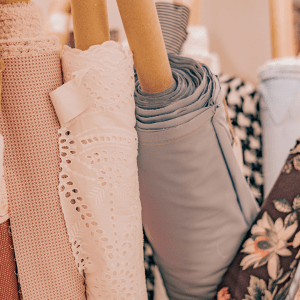
Proper storage of fabrics is essential for easy access and preservation. We’ve gathered a few tips for getting your storage well organized.
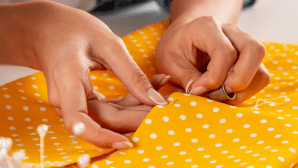
  • Categorize and Sort: Start by categorizing your fabric based on different criteria, such as color, fabric type, or project type. This will make finding the fabric you need easier when starting a new project.
  • Use Clear Containers or Bins: Store your fabric in clear plastic containers or bins. This lets you see the contents at a glance, saving time and effort when searching for specific fabrics.
  • Fold and Label: Fold your fabric neatly and uniformly to maximize space and prevent wrinkles. Use labels or tags to identify the fabric type, color, yardage, or other relevant details. This makes it easier to locate specific fabrics without unfolding everything.
  • Vertical Storage: Consider storing your fabric vertically rather than horizontally. This method saves space and allows you to easily browse through the fabric stacks without disturbing the neatly folded fabrics.
  • Utilize Shelving or Cubbies: Install shelves or use cubbies to store your fabric. These provide a dedicated space for each fabric category and help organize your sewing room. You can even sort fabrics by size or project type within each shelf or cubby.

Organize Your Notions and Tools:
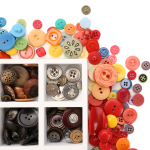
Organizing notions and tools in your sewing and quilting room is essential for maintaining a functional and efficient workspace. Start by grouping similar items, such as needles, pins, and buttons. Utilize clear plastic containers, small jars, or compartmentalized organizers to store these smaller items, ensuring they are easily accessible and visible. Consider using a pegboard or wall-mounted tool organizer to hang scissors, rulers, and other frequently used tools, keeping them within reach and saving valuable workspace.

Designate specific shelves or drawers for larger tools like cutting mats and rotary cutters to keep them safely stored and neatly organized. Additionally, labeling containers or using clear bins for items like zippers, ribbons, and trims can make it quick and easy to find what you need. By implementing a well-thought-out organization system, you’ll streamline your sewing and quilting process and have a clutter-free environment that inspires creativity!

Organizing Those Threads and Bobbins:
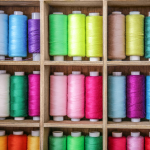
Practical thread and bobbin organization in your sewing and quilting room is crucial for a smooth and efficient workflow. To keep your threads easily accessible and neatly arranged, consider using a thread rack or spool holder. These can be mounted on the wall or placed on a table or shelf, providing a convenient display of your thread collection. Group threads by color or type, allowing for quick identification and selection. Alternatively, you can store threads in clear plastic containers or drawers, protecting them from dust and light exposure.

To keep your bobbins organized, use a bobbin storage case or tray specifically designed for holding bobbins securely in place. This prevents them from unwinding and tangling. You can also match bobbins with corresponding thread spools, storing them together to easily locate the appropriate combination when needed. By implementing an effective thread and bobbin organization system, you’ll save time and frustration, allowing for a more enjoyable sewing and quilting experience.

Creating Your Workflow:

Creating an efficient workflow in your sewing and quilting room is essential for maximizing productivity and enjoying a seamless creative process! Start by organizing your workspace in a way that suits your working style. Arrange your sewing machine, cutting table, and ironing station in a seamless layout, and ensure easy access to all your needed tools and materials. Consider setting up your own assembly line for different stages of the process! Such as cutting, piecing, and assembly, to keep everything organized and efficient.

Next, establish a workflow that works best for you! Start by planning your projects in advance. Gather your fabric, confirm your pattern, and have your cutting instructions ready. With a clear roadmap, you can avoid unnecessary interruptions or backtracking during the creative process.
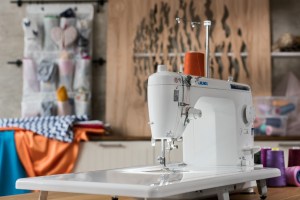
Prioritize tasks and break your sewing down into manageable steps! This allows you to focus on one project piece at a time, cutting fabric, sewing seams, or ironing. Remember to declutter and tidy your workspace to maintain a clear and inspiring workspace. By creating an efficient workflow tailored to your needs, you’ll be able to fully immerse yourself in your sewing and quilting projects, resulting in beautifully crafted creations!

Inspiring and Personalized Decor:

Create an inspiring environment in your sewing room by adding personal touches and decorative elements. Display finished projects, hang inspirational quotes, or place around artwork that sparks your creativity. Look into incorporating good lighting to avoid eye strain during your project creation. Maybe add a pinboard or corkboard to pin inspiration, project ideas, or fabric swatches!

A well-organized sewing room is a haven for creativity and productivity. By implementing the tips and tricks in this blog post, you can create a functional and inspiring workspace that enhances your sewing experience. From efficient fabric storage to optimizing workflow and adding personal touches, these strategies will help you maximize your sewing space and enjoy a clutter-free environment. Embrace the joy of organization and watch your sewing projects flourish in a space designed for creativity and efficiency. Happy sewing!
Sewing Haunted Halloween Delights

Halloween, the most thrilling time of the year, offers a perfect opportunity for crafty individuals to unleash their creativity. If you have a JUKI sewing machine, you’re in luck! JUKI machines are renowned for their quality, precision, and versatility, making them ideal for various sewing projects. In this blog post, we will explore beginner-friendly Halloween projects you can create using your JUKI sewing machine. Get ready to infuse some spookiness into your sewing skills and bring the Halloween spirit to life!

Spooky Placemats:

Transform your dining table into a haunted feast with custom Halloween-themed placemats. Choose spooky fabric prints like spiders, bats, or jack-o’-lanterns and cut them to the desired size. Use your JUKI sewing machine to hem the edges neatly. To add an extra touch, sew on appliqués, such as a ghost or a witch’s hat, to each placemat. These simple yet stylish placemats will delight your guests during Halloween dinner parties!

Trick-or-Treat Bags:

Nothing says Halloween like trick-or-treat bags filled with sweet surprises. Create your unique bag using your JUKI sewing machine and some festive fabric. Cut two rectangular pieces of fabric and sew them together, leaving the top open. Add a handle using a coordinating fabric strip. To make it even more exciting, consider adding Halloween-themed appliqués, such as a black cat or a pumpkin, to the front. Your trick-or-treat bag will be the envy of the neighborhood!

Join us on our project page here to create a Halloween trick-or-treat bag with JUKI!

Decorative Pillow Covers:

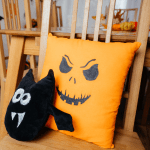
Give your living room a spooky makeover with Halloween-themed pillow covers. Select fabrics in eerie colors like black, orange, or purple. Measure your pillows and cut the fabric accordingly, leaving enough allowance for sewing. Use your JUKI sewing machine to sew the sides together, leaving one end open for inserting the pillow. For added flair, sew on decorative elements like ribbons, lace, or felt appliqués in the shape of bats, spiders, or ghosts. These pillow covers will add a touch of Halloween charm to your home decor.

Costume Accessories:

Elevate your Halloween costume by crafting unique accessories with your JUKI sewing machine. The possibilities are endless, whether you want to be a witch, a vampire, or a superhero. Create a witch’s hat by sewing black fabric together, forming a cone shape. Embellish it with ribbons or sequins. Craft bat or spider wings using fabric and wire, and attach them to a black leotard for a DIY superhero or fairy costume. The JUKI sewing machine’s precision stitching will ensure your costume accessories are sturdy and long-lasting.

Halloween Garland:

Deck your halls with a spooktacular Halloween Garland. Cut out triangular or rectangular pieces of fabric in Halloween colors and patterns. Sew the pieces together using your JUKI sewing machine, leaving a small opening at each end. Turn the fabric right side out and press it flat. String the banner pieces together with ribbon or bias tape, and hang it above your mantelpiece or doorway. Add flair by attaching felt or fabric letters that spell out “BOO” or “Happy Halloween.” Your banner will set the mood for a frightfully delightful celebration!

Check out how we created this set here for Valentine’s and design it for your Halloween theme!

With your JUKI sewing machine as your trusted companion, you can dive into the world of Halloween crafts and create delightful projects that will add charm and spookiness to your celebrations. The possibilities are endless, from decorative items like placemats and pillow covers to costume accessories and banners. So, gather your fabric, thread your JUKI sewing machine, and let your imagination run wild this Halloween season. Prepare to impress your friends and family with your handmade creations and have a hauntingly good time!

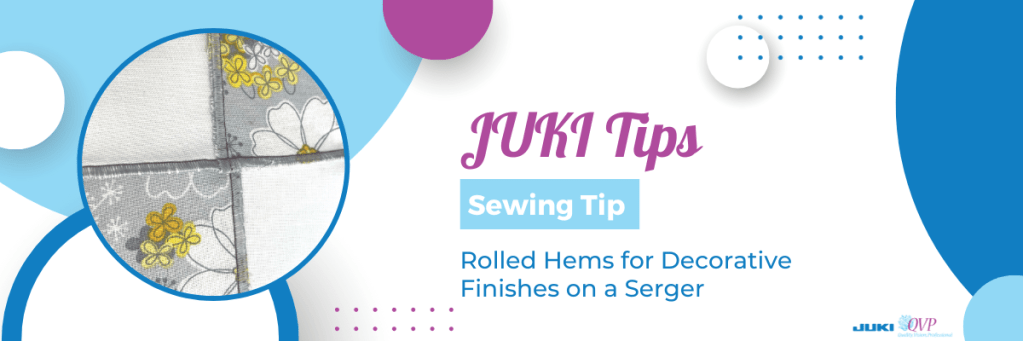
JUKI Tip: Rolled Hem for Decorative Stitches

In this month’s tip, JUKI National Account Trainer Alba showcases how to use rolled hems as a decorative touch to your quilt projects and create this on the Serger. In this video, we’ll be using our latest MO-3000QVP model.

Follow along below for a rundown of what Alba covers on today’s JUKI Tip!

Hello all my JUKI friends, welcome to another JUKI tips and tricks. My name is Alba and today we’re talking sergers.

I am working on the MO3000, but this can be done with any serger. So, today I’m talking about rolled hems, and mostly everyone uses a roll hem to finish up a hem. I’m going to take it to my next quilt project and use it as a decorative finish. I’m working on a chandelier Quilt Block. it is a very easy block to do, and I just wanted to give it a Decorative Touch. So what I have done on this one, is I’ve added is a rolled hem, and I’m doing a wide rolled hem so that it catches more of the fabric and I am going to create that Quilt Block using that rolled hem as my actual seam and that Decorative Touch. Now when you are doing this I would not recommend using woolly nylon, which is typically used for a rolled hem, because when you do press your blocks the woolly nylon may melt at the higher settings. Now, I’m going to bring this to the machine and finish up this Quilt Block.

I am at the MO 3000, but you can use any serger that allows you to do a rolled hem. Now the trick to doing that rolled hem, is placing the fabric right side out and my wrong sides together; so opposite of how you would normally put your fabric together. Now here at my intersection, I am going to show you just like we alternate the seams, I have alternated and nested those rolled hems. So I will be bringing this to my machine and sewing, and I am going to get as close as I can to show you exactly what I’m doing.

Now I am lining up my fabric just before my needles, and I am bumping it up against the knife, and I have left the knife up to catch any of those little fraying edges that can happen on cotton fabric. Now, I am going to start slowly and then build up speed, and I am going to go over all of those. Now I have not pinned, so I am just Gathering and making sure my pieces are together, and I’m sewing all the way down that edge, and surging off and I am going to cut right to the edge because I know that all of my seams will be covered in another seam.

Now I am going to bring this to the table, and I am going to just finger press but you would really want to bring that to your iron, but look at how lovely that is with that thread detail and that’s going to be 3D where it will be dimensional and just give this Quilt Block a lot of texture. So just a tip that rolled hems are not just for hems they’re great for decorative touches. So I would love to see this also on garments as an exposed seam.

I’m so glad you were able to join me with this tip, and I wanted you to get a really closeup look at how pretty that just three-dimensional finish looks on that Quilt Block. So don’t forget to give me your messages and give me some other things that you’d like to see tips on. Make sure to like and share with all of your friends so that they could get these amazing JUKI tips see you next time, bye-bye!

Trick or Treat with Decorative Stitches!

Get ready to add a touch of enchantment to your Halloween sewing projects with JUKI! Our DX and HZL series machines are the ultimate companions for sewists and quilters looking to bring their Halloween costume ideas to life. With a wide array of decorative stitches and innovative features, these machines will transform your creative visions into reality. Whether you’re stitching intricate spiderwebs onto a witch’s cloak or crafting spooky embroidery for a ghostly gown, the DX and HZL series ensures precision and ease.

Don’t miss this opportunity to unlock the full potential of your Halloween costume designs and make this October unforgettable with JUKI’s exceptional sewing technology. It’s time to sew magic into every stitch and enchantment into every costume!

Learn more by visiting your nearest JUKI dealer here.

Quilters’ Sewing 101: Answering 5 Basic Questions

Quilting is a timeless craft that has allowed us to create beautiful and functional art pieces using fabric and thread. Whether you’re a beginner or have some quilting experience, you may have questions that need clarification. In this blog post, we will address five popular questions often asked by quilters. By understanding these fundamental aspects, you’ll be on your way to confidently quilting and creating those stunning quilts you’ve been dreaming of.

What is the difference between quilting cotton and regular cotton fabric?

Quilting cotton and regular cotton fabric differ primarily in construction and intended use. Quilting cotton is designed for quilting projects and is known for its tightly woven and durable nature. It typically has a higher thread count, which means that the fabric is made up of more threads per square inch. This dense weave gives quilting cotton its sturdiness, making it ideal for stitching and holding up to repeated use and washing. Additionally, quilting cotton often features vibrant prints and patterns, which add aesthetic appeal to quilts and other sewing projects.

On the other hand, regular cotton fabric refers to the broad category of cotton textiles used in various applications, including clothing, home décor, and crafts. Regular cotton fabric comes in different weights, weaves, and finishes to suit other purposes. Unlike quilting cotton, the regular cotton fabric may have a looser weave and a lower thread count, making it lighter and more breathable. It is commonly used for making garments such as t-shirts, dresses, and pants and crafting household items like curtains, pillowcases, and tablecloths.

What is the importance of accurate seam allowances in quilting?

Accurate seam allowances play a crucial role in quilting, ensuring the final project’s overall quality, precision, and consistency. Firstly, precise seam allowances help maintain the structural integrity of the quilt by ensuring that the fabric pieces are securely joined together. Accurate seam allowances ensure that the seams are strong and reliable, preventing unraveling or fraying of the fabric over time. This is especially important for quilts that will be used, washed, and handled frequently!

Secondly, precise seam allowances contribute to the quilt design’s overall visual appeal and accuracy. Quilts often involve intricate patterns and designs that rely on precise measurements and seam allowances. Consistently accurate seam allowances ensure that the blocks and elements of the quilt fit together seamlessly, creating clean lines, even corners, and balanced proportions. Inaccurate seam allowances can lead to mismatched points, distorted shapes, or misaligned seams, which can detract from the quilt’s visual impact and overall aesthetic. Quilters can achieve a professional finish by paying attention to precise seam allowances and bringing their envisioned design to life.

How do I prevent fabric stretching while quilting?

Preventing fabric stretching is crucial in quilting to ensure accurate piecing and maintain the integrity of your quilt blocks. Here are two key techniques to help you prevent fabric stretching:

Proper handling and pinning: When working with fabric, especially bias-cut pieces, handle them with care to minimize stretching. Avoid pulling or tugging the fabric excessively, as this can distort its shape. Instead, support the fabric with one hand while guiding it through the sewing machine with the other. Additionally, use pins to secure your fabric layers together before stitching. Place the pins perpendicular to the seam line, with the heads pointing away from the sewing direction. This technique will help keep the fabric in place during sewing and prevent stretching caused by shifting layers.

Stabilizing techniques: Stabilizing the fabric can also help minimize stretching. One effective method is using spray starch or fabric sizing. Lightly spray the fabric with starch or sizing and press it with an iron before cutting and piecing. This process stiffens the fabric temporarily, making it less prone to stretching. Follow the manufacturer’s instructions and test on a scrap piece of fabric first to avoid any adverse effects. Another technique is to use a stabilizer such as lightweight fusible interfacing or wash-away stabilizer. These products provide temporary support to the fabric and can be applied to specific areas or the entire fabric piece, depending on your needs.

These techniques will help any beginner or everyday quilter!

Should I prewash my fabric before quilting?

The decision to prewash fabric before quilting is a personal choice that depends on various factors. Prewashing fabric can be beneficial in addressing potential shrinkage and removing excess dyes or chemicals. By washing the fabric before cutting and piecing, you can ensure that any shrinkage occurs beforehand, reducing the risk of distortion or warping in your finished quilt. Additionally, prewashing helps remove residual substances that may bleed onto other fabrics or affect the overall appearance of your quilt. It can be advantageous when working with different fabric types with varying shrinkage rates in the same project.

On the other hand, some quilters prefer to avoid prewashing fabric to maintain its stability and finish. Prewashing can cause the fabric to lose some of its sizing or stiffness, potentially impacting the ease of cutting and piecing. Certain fabrics, such as precuts or those with delicate prints or embellishments, may be unsuitable for prewashing due to their fragile nature. In such cases, alternative precautions like color-catching sheets or test-washing small fabric pieces can help prevent bleeding without prewashing.

Ultimately, the decision to prewash fabric before quilting is a personal preference based on the desired outcome, fabric type, and project requirements. Considering factors such as shrinkage, potential bleeding, and fabric stability can help you decide whether to prewash or not.

How can I achieve precise quilting lines or designs?
Using rulers with your JUKI sewing machine can be highly beneficial to achieve precise quilting lines or designs. Here’s a step-by-step guide on how to utilize JUKI rulers for accurate quilting:

Step 1: Prepare your fabric and JUKI ruler: Start by ensuring your fabric is properly layered and basted for quilting. Then, select the appropriate JUKI ruler for the design or quilting lines you wish to create. JUKI offers a range of rulers specifically designed for quilting purposes, such as straight rulers, curved rulers, and specialty rulers for different patterns and shapes.

Step 2: Secure and position the ruler: Place your ruler on the fabric, aligning it with the desired quilting line or design. Use fabric grips or non-slip adhesive tape to secure the ruler, ensuring it remains stable and doesn’t shift during quilting. It’s vital to position the ruler accurately to achieve precise results.

Step 3: Quilt along the ruler edge: Once the ruler is secured, guide your JUKI sewing machine’s foot along the ruler’s edge. Ensure to maintain a steady speed and apply gentle pressure to the ruler to prevent it from moving. As you quilt along the ruler, the foot of the machine will follow the ruler’s edge, resulting in clean and precise quilting lines or designs.

Remember to practice and experiment with different rulers and techniques to achieve the desired quilting effects. It’s also essential to familiarize yourself with the features and settings of your specific JUKI sewing machine to ensure optimal performance during quilting.

As a quilter, understanding the basics is essential for successful and enjoyable quilting projects. By addressing these five common questions, you can better grasp the differences between quilting cotton and regular cotton fabric, the importance of accurate seam allowances, preventing fabric stretching, deciding whether to prewash fabric and achieving precise quilting lines or designs. With this knowledge, you can confidently embark on your quilting journey, create stunning quilts, and continue expanding your quilting skills. Looking for quilting machines? Be sure to check out JUKI’s wide range of machines! Happy quilting!