Efficient Stitches: Sewing Room Organization Tips

A well-organized sewing room or dedicated sewing space can be the key to a productive and enjoyable sewing experience. From neatly storing fabrics and notions to creating a good workflow, a functional workspace allows you to focus on your creative projects without the frustration of clutter! This blog post will explore practical tips and tricks for organizing your sewing room, innovative storage solutions, and space-saving ideas. Get ready to transform your sewing space into a haven of creativity and efficiency!

Start Evaluating and Decluttering:

Start your sewing room organization journey by evaluating your current setup and decluttering unnecessary items. Sort through your fabrics, threads, and notions, and donate or discard anything you no longer need or use. By minimizing clutter, you’ll create more space and make finding and accessing the supplies you truly need easier.

Plan Your Fabric Storage:

Proper storage of fabrics is essential for easy access and preservation. We’ve gathered a few tips for getting your storage well organized.
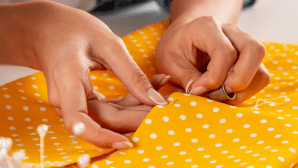
  • Categorize and Sort: Start by categorizing your fabric based on different criteria, such as color, fabric type, or project type. This will make finding the fabric you need easier when starting a new project.
  • Use Clear Containers or Bins: Store your fabric in clear plastic containers or bins. This lets you see the contents at a glance, saving time and effort when searching for specific fabrics.
  • Fold and Label: Fold your fabric neatly and uniformly to maximize space and prevent wrinkles. Use labels or tags to identify the fabric type, color, yardage, or other relevant details. This makes it easier to locate specific fabrics without unfolding everything.
  • Vertical Storage: Consider storing your fabric vertically rather than horizontally. This method saves space and allows you to easily browse through the fabric stacks without disturbing the neatly folded fabrics.
  • Utilize Shelving or Cubbies: Install shelves or use cubbies to store your fabric. These provide a dedicated space for each fabric category and help organize your sewing room. You can even sort fabrics by size or project type within each shelf or cubby.

Organize Your Notions and Tools:
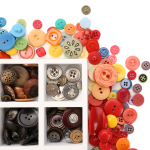
Organizing notions and tools in your sewing and quilting room is essential for maintaining a functional and efficient workspace. Start by grouping similar items, such as needles, pins, and buttons. Utilize clear plastic containers, small jars, or compartmentalized organizers to store these smaller items, ensuring they are easily accessible and visible. Consider using a pegboard or wall-mounted tool organizer to hang scissors, rulers, and other frequently used tools, keeping them within reach and saving valuable workspace.

Designate specific shelves or drawers for larger tools like cutting mats and rotary cutters to keep them safely stored and neatly organized. Additionally, labeling containers or using clear bins for items like zippers, ribbons, and trims can make it quick and easy to find what you need. By implementing a well-thought-out organization system, you’ll streamline your sewing and quilting process and have a clutter-free environment that inspires creativity!

Organizing Those Threads and Bobbins:
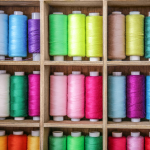
Practical thread and bobbin organization in your sewing and quilting room is crucial for a smooth and efficient workflow. To keep your threads easily accessible and neatly arranged, consider using a thread rack or spool holder. These can be mounted on the wall or placed on a table or shelf, providing a convenient display of your thread collection. Group threads by color or type, allowing for quick identification and selection. Alternatively, you can store threads in clear plastic containers or drawers, protecting them from dust and light exposure.

To keep your bobbins organized, use a bobbin storage case or tray specifically designed for holding bobbins securely in place. This prevents them from unwinding and tangling. You can also match bobbins with corresponding thread spools, storing them together to easily locate the appropriate combination when needed. By implementing an effective thread and bobbin organization system, you’ll save time and frustration, allowing for a more enjoyable sewing and quilting experience.

Creating Your Workflow:

Creating an efficient workflow in your sewing and quilting room is essential for maximizing productivity and enjoying a seamless creative process! Start by organizing your workspace in a way that suits your working style. Arrange your sewing machine, cutting table, and ironing station in a seamless layout, and ensure easy access to all your needed tools and materials. Consider setting up your own assembly line for different stages of the process! Such as cutting, piecing, and assembly, to keep everything organized and efficient.

Next, establish a workflow that works best for you! Start by planning your projects in advance. Gather your fabric, confirm your pattern, and have your cutting instructions ready. With a clear roadmap, you can avoid unnecessary interruptions or backtracking during the creative process.
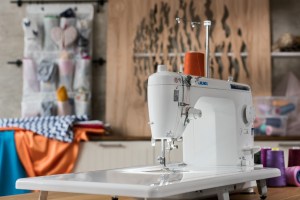
Prioritize tasks and break your sewing down into manageable steps! This allows you to focus on one project piece at a time, cutting fabric, sewing seams, or ironing. Remember to declutter and tidy your workspace to maintain a clear and inspiring workspace. By creating an efficient workflow tailored to your needs, you’ll be able to fully immerse yourself in your sewing and quilting projects, resulting in beautifully crafted creations!

Inspiring and Personalized Decor:

Create an inspiring environment in your sewing room by adding personal touches and decorative elements. Display finished projects, hang inspirational quotes, or place around artwork that sparks your creativity. Look into incorporating good lighting to avoid eye strain during your project creation. Maybe add a pinboard or corkboard to pin inspiration, project ideas, or fabric swatches!

A well-organized sewing room is a haven for creativity and productivity. By implementing the tips and tricks in this blog post, you can create a functional and inspiring workspace that enhances your sewing experience. From efficient fabric storage to optimizing workflow and adding personal touches, these strategies will help you maximize your sewing space and enjoy a clutter-free environment. Embrace the joy of organization and watch your sewing projects flourish in a space designed for creativity and efficiency. Happy sewing!
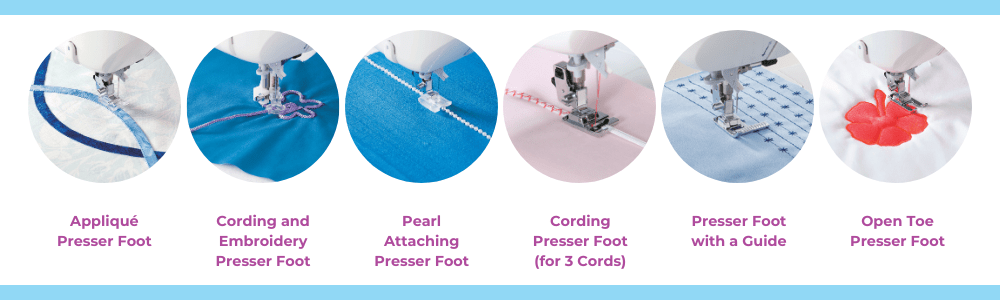
Exploring the Creative Set with JUKI

The Creative Set Accessory Kit by JUKI is a treasure trove for sewists looking to expand their creative possibilities. With an assortment of specialized presser feet and essential accessories, this kit allows you to add unique and professional touches to your sewing projects. In this blog post, we’ll explore the presser feet included in the Creative Set and their various applications. From appliqué to pearl attaching and cording, we’ll also provide project ideas that showcase the versatility and potential of these fantastic accessories.

The appliqué presser foot is designed to facilitate the application of appliqué designs onto fabric. It allows for precise stitching along the edges of the appliqué pieces, securing them in place seamlessly. Use the appliqué foot for quilts, garments, and home decor projects to add decorative fabric shapes or motifs. Create beautiful appliqué designs on t-shirts, table runners, or personalized pillows.

This presser foot is a versatile tool for embellishing your sewing projects with decorative cords or embroidery threads. It has a groove on the underside that holds the cord or thread, allowing it to be stitched securely in place. Use this foot to add texture and dimension to garments, handbags, or home decor items. Create unique corded or embroidered designs on collars, cuffs, or even the edges of tote bags or cushion covers.

The pearl-attaching presser foot is designed to attach pearls or beads to fabric. It has a channel that holds the pearls in place as you sew, ensuring even spacing and secure attachment. This foot is perfect for adding elegant and eye-catching details to bridal wear, evening gowns, or accessories like clutches and headbands. Create stunning pearl trims on necklines, bodices, or along the edges of a veil.

The cording presser foot for three cords is ideal for incorporating multiple cords into your sewing projects. It allows you to guide and stitch three cords simultaneously, creating beautiful raised designs or decorative trims. Use this foot to add intricate corded details on garments, such as piping on collars or bodices. You can also use it to create unique corded accents on bags, belts, or home decor items like curtains or cushions.

The presser foot with a guide is a versatile accessory that helps you achieve accurate and consistent seam allowances. The guide runs along the fabric’s edge, ensuring precise stitching and alignment. This foot is perfect for projects that require precise topstitching or edge stitching, such as quilt bindings, bag handles, or garment details like collars and cuffs.

The open-toe presser foot provides excellent visibility, making it ideal for projects that require precise stitching along marked lines or intricate patterns. Its open front lets you see the stitching area clearly, making it suitable for quilting, appliqué, or free-motion embroidery. Use this foot to create intricate quilt designs, stitch along curves, or add decorative motifs to the fabric.

Quilted Appliqué Pillow: Use the appliqué presser foot to create beautiful fabric shapes on a quilted pillow cover, adding texture and visual interest.

Embellished Tote Bag: Utilize the cording and embroidery presser foot to add decorative cords or threads to a plain tote bag, creating a unique and personalized accessory.

Pearl-Trimmed Evening Dress: Attach pearls using the pearl attaching presser foot to the neckline or bodice of an evening dress, adding an elegant and sophisticated touch.

Corded Collar Blouse: Incorporate multiple cords with the cording presser foot (for 3 cords) to create a striking corded collar detail on a blouse, making it a standout garment.

Topstitched Quilted Table Runner: Use the presser foot with a guide to achieve precise topstitching on a quilted table runner, enhancing its visual appeal.

The Creative Set Accessory Kit by JUKI provides a range of specialized presser feet and accessories to elevate your sewing projects. These presser feet open up endless creative possibilities, from appliqué and cording to pearl attaching and topstitching. Incorporate these accessories into your sewing projects and bring your unique ideas to life. Unleash your creativity and let the JUKI Creative Set inspire your sewing journey!

Stay tuned for a future JUKI Tip to showcase these accessories!

Know Your Needles with JUKI

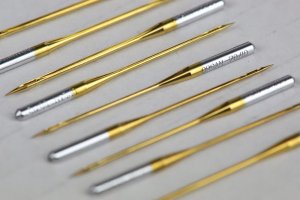
When creating, you may wonder, what needle should I use on my machine and project? Today we will give you a lesson on needles and what you need to know before you start sewing your next idea. Understanding what needle you need will help you create without the mess of skipped stitches, a thread coming loose, a pucker in your fabric, and so much more. Let’s start from the bottom and work up to picking the right needle.

How do you read the needle size?

Depending on your fabric, you’ll want to find a needle that can puncture the fabric well but not tear it when you are sewing.

The needle size ranges from small to large, and each sewing machine needle will have two numbers etched onto it. Usually separated by a slash, these numbers determine whether it is a heavy-duty needle. 60/8, for example, is a lightweight needle suitable for cotton. At the same time, 90/14 is a heavyweight needle good for vinyl. 

Now what do those numbers mean exactly? The first number is measured in the European/Number Metric (NM)/International system, for example, the 60 in 60/8. The metric number usually increases by 5 or 10 when you need to size up your needle for heavier fabric. Home sewing machine needle’s most common metric size is between 60 and 130.

The second number is measured in the American/U.S./Singer/Imperial system, for example, the 8 in 60/8. For your home sewing machine, the most common imperial size needed is between 8 and 21, and the needle sizes usually increase by 1 or 2.

How do you choose the right needle?

There are a few brand options for sewing machine needles, but today we will discuss Organ needles. When choosing a needle, our best recommendation is to pick the smallest one possible for the fabric you’re working with. Needles will leave holes in your fabrics as it goes, so you want to minimize the view of them.

Now know you’ll need to find the right needle for your fabric, we’ve compiled a list of fabrics and the recommended organ needle size to use when creating.

Fine Fabric: Silk, chiffon, and lace

  • Silk 55/7; Microtex 60/8 and 70/10

Lightweight Fabric: Cotton or spandex

  • Universal 80/12; Jersey 70/10 or 75/11; Super Stretch 75/11

Medium-Weight Fabric: Linen, fleece, velvet

  • Universal 80/12 or 90/14; Jersey 90/14; Super Stretch 90/14

Heavyweight Fabric: Leather, canvas, denim

  • Jeans (blue shank) 90/14 and 100/16

Very Heavyweight Fabric: upholstery or heavy denim

  • Titanium 90/14; Jeans (blue shank) 110/18

For all needles, including Organ needles, these are things to keep in mind:

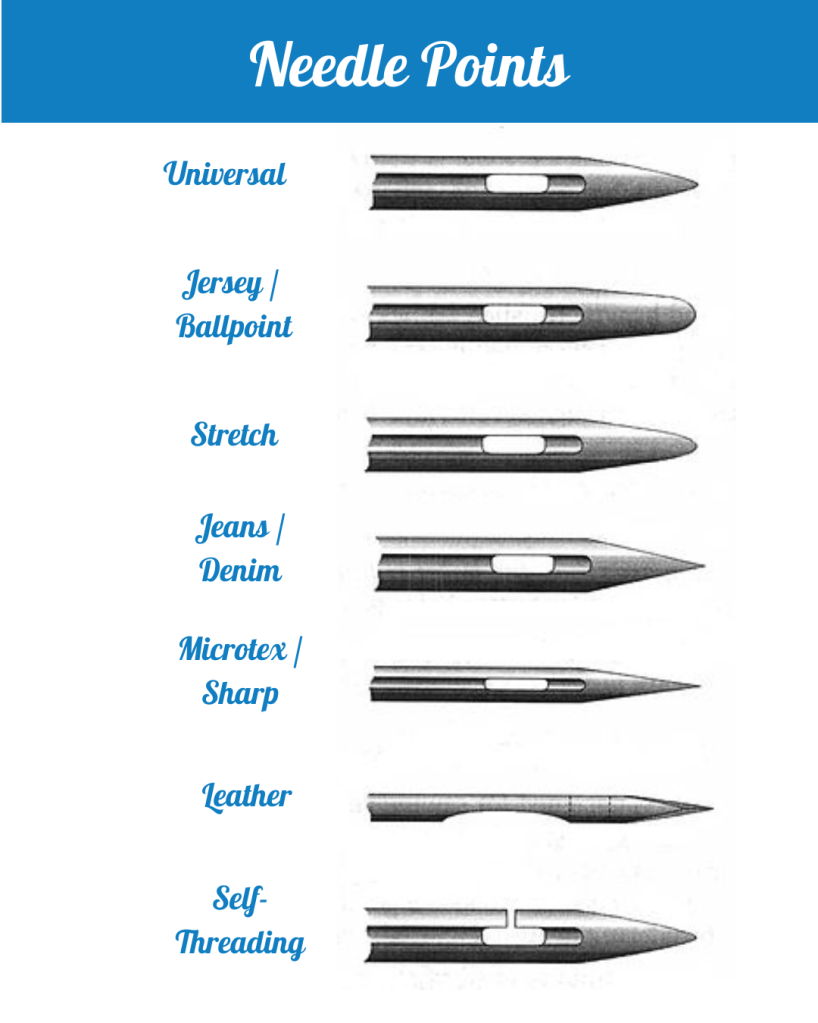
  • Universal Needle is the most commonly used needle on a home sewing machine. It can be used on woven fabrics, synthetics, and knit fabrics. A universal needle should use polyester, cotton, or silk threads.
  • Ball Point Needle: with a rounded tip on the needle, this is commonly used for rib knits, interlock, cotton knits, fleece, double knit, and most knit fabrics. This is because the ballpoint pushes the fabric fibers apart rather than cutting them, preventing stitch runs.
  • Stretch Needle: with a scarf tip, this needle allows the hook to pass by and prevent skipped stitches when working on fabrics like stretch knits, silk jerseys, or spandex.
  • Jean Needle: You might have noticed above that Organ recommends a jean needle when working on denim material; this is because the very sharp point on the Jean needle can handle that firm fabric and cleanly pierce through. You can also use this on heavy canvas fabric or home décor linens. This is a perfect moment to study your thread too! If you’re working with threads like 100% polyester or heavier top stitching threads, this needle will help you create easier.  
  • Sharp Needle: Quilters might know about this one. A sharp needle can penetrate through multiple layers of fabrics, like for quilting creations that involve several layers of cotton and padding. Helpful for preventing skipped stitches and needles breaking, a shark needle is an excellent needle to have no hand.
  • Quilting Needle: Quilters can also get the traditional quilter needles created for penetrating several layers of fabrics in projects. You will notice that quilter needles are a little shorter than Sharp needles. Choose the best needle size for your needs!

Remember, the thread you’re using for your sewing project will also determine the type of needle you choose! For example, if you’re creating with a fine thread, you’ll want to use a small needle size to reduce the thread from falling out the eye of the needle. Also, remember that the lighter the fabric, the smaller the needle size, and the heavier the fabric, the larger the needle size.

We hope this helps you create your next project as you use the right needle on your creation! To learn more about Organ needles, visit here.

JUKI Star Spotlight: Meet Bill from BILLIAM

BILLIAM, a custom jean company based out in Greenville, South Carolina, was founded by Bill Mitchell in 2009 right out of his family’s basement. Over the years since opening, Bill’s business has flourished and has continued to thrive as fashion lovers all over the world find him. Today we’re going to take you behind the scenes of BILLIAM and their two-man show where they showcase the process of ordering your own custom jeans and the work that goes into the designs we love.

Follow along below for the transcript version of our interview with Bill Mitchell from BILLIAM

Hey guys, my name is Bill Mitchell, from BILLIAM Jeans, we are a custom jean company based in Greenville, South Carolina, and we’ve been making jeans since 2009 for people, and essentially what we do is we take your measurements, we show you different fabrics you can choose, and then we build you anything you want from scratch.

Now the process of buying a pair of jeans from us is you schedule an appointment to come into our store; you come in, and we will take your measurements, and then we’ll show you different fabrics that you can choose, and then we’ll sit down, and we’ll talk about the different style you want.

So if you wanted something that would be skinny, slim, straight, layered, baggy, whatever that is, we can kind of make those creative decisions after we get your measurements. Then it takes about a month to have us produce that pants for you. then we ship it to you, or you can come into the store and pick it up.

If you don’t live in Greenville and you can’t make it into our shop, then we can do all of this over Facetime. So you can set up a time to Facetime with us with a measuring tape, and I will walk you through the entire process as if you’re here in the store but from the comfort of your own home.

What inspired you to start sewing?

So in the seventh grade, I took a home ec class, and that was the first time I learned I could use fabric and a sewing machine to build things from scratch, and it was a really fun, powerful moment where I had built something that I was proud of.

In college, I started tailoring clothes for myself, and I realized I could start tailoring things for other people that they could be proud of. So I needed a product that I could make that I could do that with and scale, so I chose blue jeans, and the service of tailoring clothes to people or making things bespoke to solve people’s problems was a great joy for me. I’ve spent the last 15 years doing that, and it’s a very rewarding process to get to not only make things from scratch but make things that benefit other people’s lives.

What was it like opening your first shop?

So opening my first shop was a really strange experience because I had been jeans at this point in my parent’s basement for a year and a half, and it got to the point where it was strange to have people that I didn’t know coming to my parent’s house, down to their basement fitting them for jeans, and so I knew I needed to find a place that was my own.

It kind of got to the point where I knew I needed to open up a shop. I opened up that first store and it was just a really fun experience to have something that was my own and to create an atmosphere that I could custom-tailor to the experience that I wanted to give people. Now I’ve had three or four different shops over the course of 15 years, but I’ll never forget that first shop and how fun of a time it was to do that.

How has life changed as a small business owner?

Okay, so life as a small business owner is a very strange life because, in so many ways, every day looks different. So you know, for me as an artist and as a business person, I have to stay focused and really choose what I’m going to do each day. To me, really having a concrete process of how I’m going to make things, and the different machines that I’m going to use, allows me to take an order and have a good time making that order so I can actually have a successful day.

To have JUKIs in my room that are all working, and the technology is allowing me to produce this product in a way that’s very easy is a really nice process.

What is in store for BILLIAM Jeans?

So BILLIAM has always been, essentially, a service that we offer to people, and that service through making custom jeans is a very challenging thing to scale, but there’s a different technology that I’m very curious about and am investing in currently that would allow us to make it easier to make custom jeans for people without them having to come to the store.

The future of BILLIAM is adding as much technology as we can to the fitting process so that you could essentially download an app, scan yourself from home, and do everything online. You never need to come in, and it’d be a very easy thing to just have your jeans made without having too much of a stressful experience.

In a world of evolving trends, what is your most and least favorite jeans style?

Okay, so in the world of evolving trends, specifically in jeans, you’ve seen so many things. From low-rise jeans, skinny jeans, really baggy jeans, kind of like the JNCO million pockets kind of thing. For me, I’ve always really enjoyed the people of the ’70s. I really love the flair of it, I love the colors, the style, that you know you just give this sense of freedom to fashion back in the day. So, for me, I think the most fun trend to be a part of is making a flare jean. Right now, doing it custom, you can kind of put the knee at the right place to get the flare to open up at the right proportion for somebody, and that is a lot of fun to do.

I say the least fun thing for me to make would be something that is very low-rise skinny jeans, probably. That would probably be like the very Britney Spears ’90s thing, I don’t know if that’s my thing right now. But ill probably regret saying that in 5 years.

How can a customer find BILLIAM?

So the easiest way to find us and to stay updated with all the different things we love to talk about and share with you would be Instagram. BILLIAMJeans at Instagram is the best place. if you want to see photos of the work we’ve done, you can go to our website, which is BILLIAMJeans.com, but to me, the single primary place that I like to communicate with people is through Instagram at BILLIAMJeans.

To learn more about BILLIAM visit their website or Instagram! Thank you for joining us today in getting to know Bill Mitchell and his shop BILLIAM Jeans. We hope you get a chance to visit the next time you’re in the Greenville area of South Carolina.

JUKI Designer Ambassador: Mah-Jing Wong

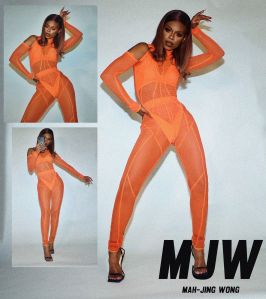
Welcoming new JUKI Designer Ambassador, meet Mah-Jing Wong! Founder and Designer for his line Mah-Jing Wong, he began sewing as a child under his grandmother’s teachings. An activity they loved doing together, sewing is the connection to his childhood and grandmother he keeps with him to this day.

His beginning in sewing is a sweet memory, with his first project being a hat! First seen on Michael Jackson and wanting his own, he went to his grandmother and asked how to create his own. From there, he completed his first project, grandmother along his side, and step by step sewed it together. This event would set the tone for his future career.

Later in life, Mah-Jing would attend the Arts Institute of Philadelphia, where he received a Bachelor of Science degree in Fashion Marketing. In his senior year, he would begin interning with top fashion designers Zac Posen. It was here that he began planning to create his own clothing brand that launched in 2011. Inspired by Japanese anime and the Marvel Comic book world, his work uses simple silhouettes with hand-dyed prints and geometrical shapes. His favorite work to create is his bodycon dresses, seen during his time as a contestant on Project Runway.

Since his time on project runway, Mah-Jing has continued to move up in the fashion industry, working with superstars such as Cardi B, Megan Thee Stallion, Chole Bailey, and many more! With his work garnering attention for its style and boldness, it has been featured in pop lifestyle settings like stage performances, music videos, and magazine covers. Mah-Jing continues to wow his followers as he works on the new collection, with orders already being placed.

With a design style that is innovative and fun, Mah-Jing’s favorite sewing trend right now is the exposed overlock thread. Using his JUKI overlock MCS-1700QVP, his favorite tool in his studio, he can create the base for all his creations and easily add this trend.

Mah-Jing states his experience in sewing has been rewarding. Like anything in life, sewing has had its ups and downs, but it remains his safe space for expressing his creativity like so many of you. His piece of advice for sewers is this, “stay calm and trust the process.” A saying we all understand in sewing and quilting.

We hope you enjoyed getting to know Mah-Jing as much as we have JUKI Lovers! So follow along with his journey and JUKI today and visit us here today!

Which fashion piece was your favorite? Let us know below!