JUKI’s Ruler Magic

Let’s discuss the not-so-secret weapon in the quilting world: JUKI rulers! From crafting loops that scream elegance to diving into intricate clamshell designs, these rulers are your ticket to a quilting adventure that’s as fun as it is fab. We will cover the options available from JUKI that you can use the next time you’re quilting. So, grab your favorite fabrics and buckle up as we explore the endless designs these rulers bring to the table and why they’re the most excellent tool in a quilter’s arsenal!

Ruler Base: Expanding Your Canvas

Before you start creating, you must ensure you have a stable place to create! The JUKI Ruler base stabilizes rulers when stitching designs, expanding the machine’s work surface around the needle plate. The set is also removable when unused, offering both convenience and versatility.

¼ Quilting Foot: Precision at Your Fingertips

The next step to a smooth sewing experience with rulers is using the ¼ quilting foot. This foot is a game-changer for quilting with Rulers! With a perfect ¼” distance from the needle entry point to the outer edge, this foot allows sewing with rulers as guides. Its lowered front enhances visibility around the needle area while the adjustable height accommodates various fabric thicknesses.

Rulers For Creating

Loop to Loop Ruler

Creating beautiful 3″ and 4″ loops becomes a breeze with the loop-to-loop ruler! Its 3/16″ thickness is ideal for low-shank sewing machines, ensuring seamless loops on your most cherished projects. This ruler creates looped borders on quilt edges, floral motifs, wave patterns, interlocking designs, and more!
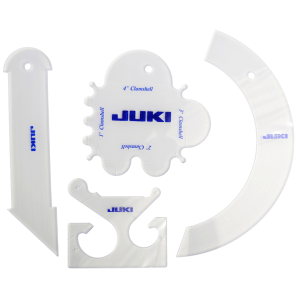
Curved Crescent Moon Rulers

Designed by Ronda K. Meyer, these rulers deliver flawless half-circles! Their 3/16″ thickness is perfect for your low-shank sewing machine and helps quilters infuse elegance effortlessly into their creations.

Some fun design ideas you can complete with the Curved Crescent Moon Rulers are arcs and swirls, petal patterns for your floral motifs, feathers or whimsical spirals, or border elements!

Mini Straight-Line Ruler

Stitching in the ditch is a breeze with this 3/16″ thick acrylic tool! The ruler has indented edges, which helps you maintain accurate placement, and the versatile ends, one round and the other containing a 45-degree angle facilitate creating arcs, scallops, and small crosshatching.

These designs are also great if you want to create geometric patterns, create a grid pattern across your quilt, accent arcs, and scallops, and check out the ruler’s 45-degree angle to incorporate angular elements into your quilt. These angles can create unique designs, like stars, chevrons, or interlocking patterns!

Clamshell Ruler

The clamshell ruler opens doors to crafting 1″, 2″, 3″, and 4″ clamshell designs. With a 3/16″ thickness tailored for low-shank machines, this ruler invites quilters to adorn their projects with classic clamshell quilting!

You can create various patterns with the clamshell designs, integrating nested, alternating, echoing, and graduated clamshells by using your ruler in various positions. Combine these rulers to create fun and intricate designs the next time you’re quilting!
Line Art System ruler 

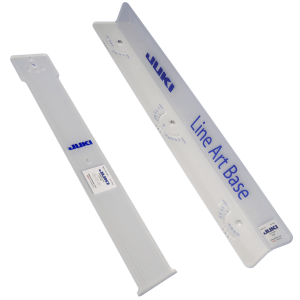
For avid creators seeking precision in straight-line designs like crosshatch, the Line Art System ruler steals the spotlight. It’s tailored perfectly for longarm quilting with a thickness of 1/4″ and measuring 3″ x 18″. It’s not just a ruler; it’s a guide to creating immaculate, geometric designs that add depth and character to your quilts.

Line Art Base 

Regarding the Line Art system ruler, the Line Art Base steps in with larger dimensions, measuring 24″ x 5″. With the same 1/4″ thickness, this ruler caters to longarm quilters looking for more extensive space to create those beautiful straight-line designs!
Ruler Set

The Ruler Sets: A Variety Sets Created For Your Needs

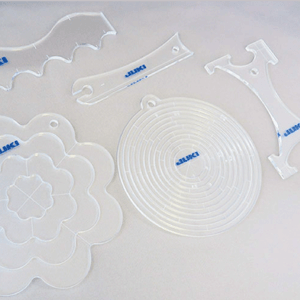
Let’s talk about the ruler sets now. Having a ruler set ready for quilting from JUKI is an absolute blast! These rulers aren’t just tools but gateways to endless design possibilities. Each set offers a unique set, whether crafting classic clamshell designs, precise straight lines, or intricate loops and curves. With various options, sets are a great way to create; they allow you to use multiple design ideas quickly and let you add texture and movement to your projects.

First Ruler Set: Crafting Basics

The foundation of quilting lies within the first ruler set! Serving as a template for stitching designs using the quilting ruler foot, this kit enables the formation of various patterns by combining primary lines and shapes. The beauty lies in its versatility; the kit is offered in three sets, allowing endless experimentation and possibilities.

With this set, you can create fun designs: geometric patterns, starburst or radiating designs, or interlocking patterns!

Second Ruler Set: Tears & Tails for Whimsical Elegance
Tears & Tails Set

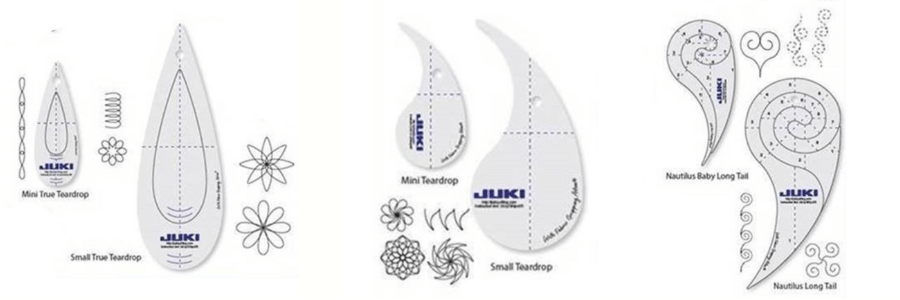
Enter the realm of whimsy and elegance with the Tears & Tails Ruler Set! One of the latest additions to our Ruler collection offers an array of rulers, including the Mini Teardrop, Small Teardrop, Nautilus Baby Long Tail, Nautilus Long Tail, Mini True Teardrop, and Small True Teardrop. Each ruler is a gateway to crafting fun and exciting patterns that infuse your quilts with personality and charm.

This set is excellent for experimenting with designs! You can test your skills at creating Floral patterns or fluttering butterflies by using the Mini True Teardrop and Small True Teardrop rulers to create symmetrical wings and the long tail rulers for elegant antennae. Or try your hand at animal-inspired designs! Use the teardrops to create feathers for birds or petals for stylized animals and the long tail rulers to form tails, fins, or antlers.

Remember, these rulers are your artistic toolkit; mixing and matching the shapes can lead to countless creative combinations!

Third Ruler Set: Hearts & Wings for Delicate Beauty
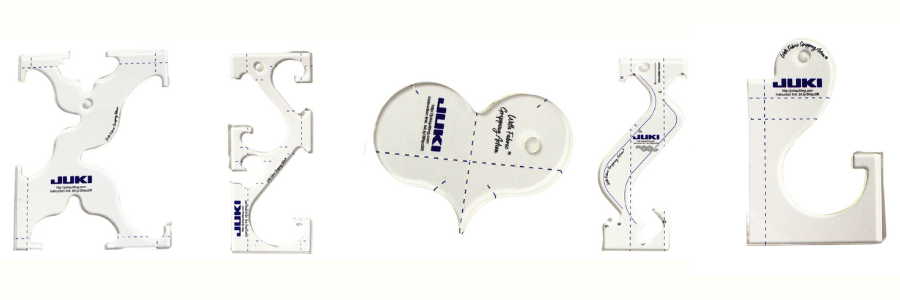
Hearts & Wings Set

Another new addition to our ruler collection is the Hearts & Wings Ruler Set! This set is a testament to delicate beauty in quilting and features rulers like the Cable Tool, Mini Heart, Traditional Hearts, Feathered Hearts, and Bird Bracket Chain. This set invites quilters to create intricate and graceful designs that add a touch of whimsy and sophistication to their projects!

There are so many possibilities with this set! Use the Cable Tool ruler to create sinuous, twisting vines reminiscent of delicate floral tendrils. Combine these vines with small heart-shaped leaves using the Mini Heart ruler, adding a touch of whimsy to your quilt. You can utilize the Traditional Hearts ruler to craft clusters of heart-shaped flowers. Vary their sizes and arrange them to mimic a blossoming garden across your quilt. Or incorporate the Bird Bracket Chain ruler into your design, creating a scene where whimsical birds perch on blooming branches!

Using a JUKI ruler while quilting can be a game-changer for several reasons. These rulers are meticulously crafted tools designed to elevate your quilting experience. Their precision and versatility offer a level of control and accuracy that’s hard to achieve freehand. Whether the Loop to Loop Ruler is for creating uniform loops or the Clamshell Ruler is for classic designs, each ruler serves as a guide, ensuring consistency and perfection in your quilted patterns. Ultimately, using a JUKI ruler is like having a trusted partner in your quilting journey—a tool that empowers you to turn your quilting visions into stunning, professional-looking masterpieces with precision, ease, and a touch of artistic flair!

To learn more about our JUKI Rulers, visit here!
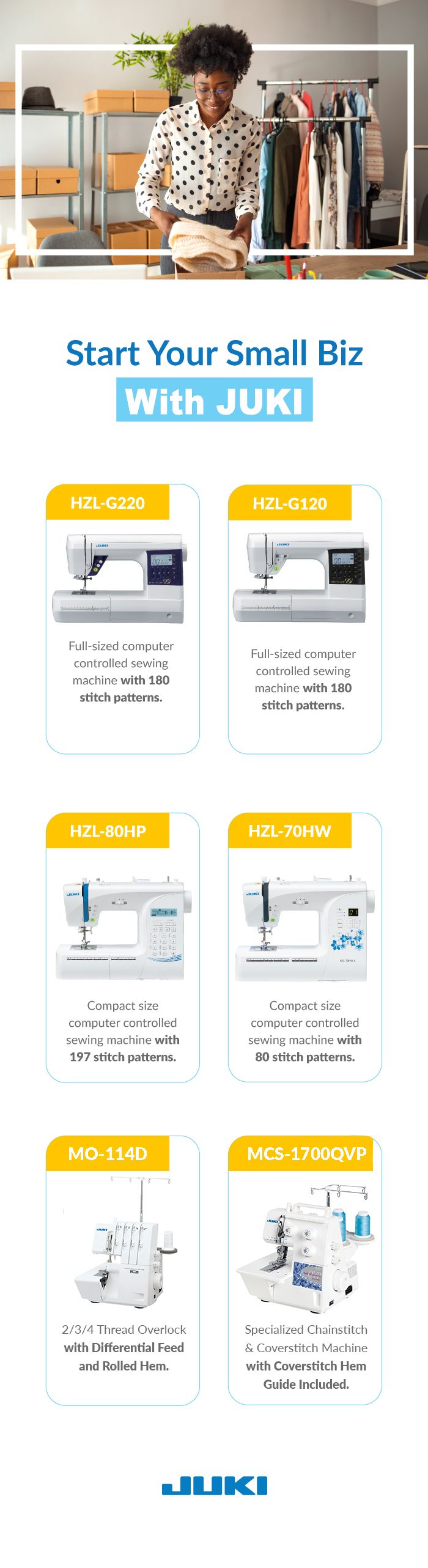
June Promotion 2023: Start Your Business with JUKI!

Join JUKI this month as we share machine options you can choose from when it’s time to start your small business! Whether you’re creating garments, or designing home decor and quilts, the range of these machines is ready to help you get started.

Contact your nearest JUKI dealer here to learn more about our JUKI machines and how to get yours today!

Know Your Stitches!

When we first try sewing, our first idea is to learn from project and instructional videos or reading pattern and sewing instruction books. One of the top things you’ll need to know about is the type of stitches you can create and when it’s time to use them on your projects! Depending on what machine you’re working on, whether you’ll be able to complete every stitch we mention below, and how you’ll be able to create it.

Let’s Get to Stitching!

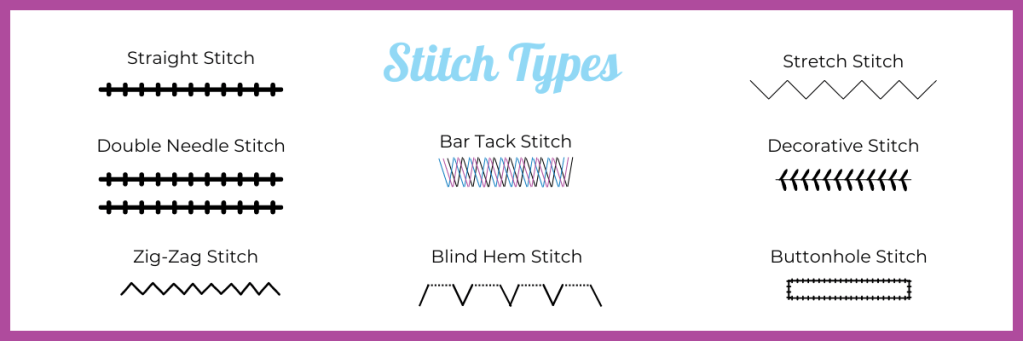
Straight Stitch: The straight stitch on all JUKI sewing machines is perfect for plain seams, darts, tucks, and topstitching! We recommend altering the stitch length to suit your project goals. The longer stitch lengths can be used for projects that require gathering or very long lengths for basting, making it easy to remove the stitches. Remember that your needle position should be set to the center of the presser foot for this to work.

Some machines will also offer a triple straight stitch. This is where the machines take 2 steps forward and one step back. This extra-strong stitch is excellent for crotches in pants where the seam is under extra stress.

Stitch Lengths to Know:

Seams and Majority Sewing: Length 2.0-3.0.

Gathering Fabric or Machine Basting Fabric: Length 4.0 is used for gathering fabric and machine basting fabric.

Double Needle Stitch: Add extra durability to your projects using this stitch! If you’re working on knits or stretch fabrics, this type of stitch creates parallel lines along the fabric and has the benefit of the fabric responding well to it.

If you’re working with woven fabrics, you won’t require this type of stitch, but it can be used to make a hem look more professional, giving your project that professionally finished look.

Keep in mind that twin needles come in a variety of sizes, and they have two number designations: one is the space between the needles, and the other is the needle size. So, for example, a 4/80 twin needle has 4 mm space between two sizes of 80 needles. Then for your extra needle, you’ll use your extra spool to place the second thread on your machine.

You can use this stitch to create decorative stitches, parallel rows of topstitching, and a coverstitch hem like those found on t-shirt hems or pintucks.

The Zig-Zag Stitch: Found on most of JUKI’s electrical and computerized machines, you won’t need to go over the fabric multiple times with this stitch! This stitch is solid and most commonly used to stop raw edges from fraying.

If you find yourself without a serger, this stitch is great for sewing knits as it has a built-in elasticity, meaning your stitches won’t break when pulled.

This stitch can also assist you in adding applique to your projects, like beautiful motifs for decoration.

Zig-Zag Width Setting Tips:

Sewing knits on the seams – We recommend a width of 1.0 and a length of 2.5. The stitch should be small and tight and look similar to a straight stitch.

Sewing knit hems – We recommend a width of 4.0 and a length of 3.0. The zig-zag should be much wider than the seams.

Finishing raw edges – We recommend a wide zigzag of width 4.0 and length 3.0 right on the edge of the fabric. This can stop your project from fraying and will increase the longevity of your creations.

Applique – We recommend a length of 0.5 and a width of 4.0. Again, you’ll want a very close zigzag stitch so that very little fabric shows between the stitches.

Blind Hem Stitch: This mix of straight and zig-zag stitches is perfect for hemming and mending your closet items! Nearly invisible, this stitch is used to either sew two pieces of fabric together or fold one fabric together.

A blind hem means you can’t see the stitching on the top of the outward-facing fabric. When done correctly, all you should see are little dots. These are the micro stitches, with all the visible stitching at the back. This stitch is perfect for skirts, dresses, and trousers with non-stretch fabrics.

You can also find presser feet accessories like the Blind Stitch Presser Foot to use in conjunction with this stitch option.

Bar Tack Stitch: This stitch was made for those areas that need extra durable stitches! Due to being in high-stress zones, you’ll want to use this stitch to reinforce project areas that are subject to stress and stretch, like your pant’s belt loops or pockets.

We also recommend this stitch for fabric bags because the stitch will provide strength to your stitches and the ability to withstand the stress of carrying multiple items.

This stitch does include the use of zig-zag and can be applied with a machine. If you want extra support, this stitch can be doubled up with a back stitch at the end of the seam.

The Buttonhole Stitch: This stitch can be used on a multitude of projects and depending on what machine you’re creating on you will either have one step to do, which measures and sews the buttonhole reinforcement for you, or take 4 steps and adjusts a few settings as it sews the 4 sides of the buttonhole.

You can use a zig-zag stitch for stitching buttonholes. Still, most sewing machines have the capability to create buttonholes with a special foot attachment or a pre-programmed buttonhole setting, like our DX-4000QVP.

 You can also use the buttonhole stitch to make sewn eyelets, attach applique to ground fabric for personalization, and as couching stitches.

Stretch stitch: Use this narrow zig-zag stitch when working with knit fabrics! While a straight stitch would break under the stretch of these fabrics, a zig-zag stitch stretches according to the fabric stretch. You might also hear this stitch called the lightning stitch or elastic stitch. This stitch can also be used to join elastic and the fabric or for mending tears in cloth!

Decorative Stitch: While not commonly picked, many electrical and computerized machines offer many decorative stitches that you can work into your everyday projects. You can experiment with different color threads and stitch options to be as creative as you want in your project designs!

We recommend stabilizers when creating with decorative stitches so that your designs don’t pucker or stretch on your fabric bases. This will help create a smooth, consistent stitch in your designs.

Keep in mind when working with decorative stitches the difficulty of removing them. These stitches can be very dense, making them easier to fix if you don’t like your chosen design. We recommend using a sample fabric to test your decorative stitch on the fabric and confirming which designs you want to use before beginning our project.

The Right Machine

When choosing your machine, remember what stitch capabilities it has and what you’ll need to create the projects you’re dreaming of. A basic sewing machine will often only offer straight stitching sewing, so if you hope to work with other stitch options like we listed above, you’ll need to broaden your machine options. To use more stitch options, like decorative stitches, we recommend researching an electrical or computerized machine like our computerized sewing machines that commonly offer a variety of stitches for your project needs.

Want to test-drive a machine and check out our stitch options? Contact your nearest JUKI dealer today here!