Efficient Stitches: Sewing Room Organization Tips

A well-organized sewing room or dedicated sewing space can be the key to a productive and enjoyable sewing experience. From neatly storing fabrics and notions to creating a good workflow, a functional workspace allows you to focus on your creative projects without the frustration of clutter! This blog post will explore practical tips and tricks for organizing your sewing room, innovative storage solutions, and space-saving ideas. Get ready to transform your sewing space into a haven of creativity and efficiency!

Start Evaluating and Decluttering:

Start your sewing room organization journey by evaluating your current setup and decluttering unnecessary items. Sort through your fabrics, threads, and notions, and donate or discard anything you no longer need or use. By minimizing clutter, you’ll create more space and make finding and accessing the supplies you truly need easier.

Plan Your Fabric Storage:

Proper storage of fabrics is essential for easy access and preservation. We’ve gathered a few tips for getting your storage well organized.
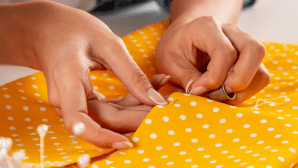
  • Categorize and Sort: Start by categorizing your fabric based on different criteria, such as color, fabric type, or project type. This will make finding the fabric you need easier when starting a new project.
  • Use Clear Containers or Bins: Store your fabric in clear plastic containers or bins. This lets you see the contents at a glance, saving time and effort when searching for specific fabrics.
  • Fold and Label: Fold your fabric neatly and uniformly to maximize space and prevent wrinkles. Use labels or tags to identify the fabric type, color, yardage, or other relevant details. This makes it easier to locate specific fabrics without unfolding everything.
  • Vertical Storage: Consider storing your fabric vertically rather than horizontally. This method saves space and allows you to easily browse through the fabric stacks without disturbing the neatly folded fabrics.
  • Utilize Shelving or Cubbies: Install shelves or use cubbies to store your fabric. These provide a dedicated space for each fabric category and help organize your sewing room. You can even sort fabrics by size or project type within each shelf or cubby.

Organize Your Notions and Tools:
Organizing notions and tools in your sewing and quilting room is essential for maintaining a functional and efficient workspace. Start by grouping similar items, such as needles, pins, and buttons. Utilize clear plastic containers, small jars, or compartmentalized organizers to store these smaller items, ensuring they are easily accessible and visible. Consider using a pegboard or wall-mounted tool organizer to hang scissors, rulers, and other frequently used tools, keeping them within reach and saving valuable workspace.

Designate specific shelves or drawers for larger tools like cutting mats and rotary cutters to keep them safely stored and neatly organized. Additionally, labeling containers or using clear bins for items like zippers, ribbons, and trims can make it quick and easy to find what you need. By implementing a well-thought-out organization system, you’ll streamline your sewing and quilting process and have a clutter-free environment that inspires creativity!

Organizing Those Threads and Bobbins:
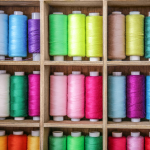
Practical thread and bobbin organization in your sewing and quilting room is crucial for a smooth and efficient workflow. To keep your threads easily accessible and neatly arranged, consider using a thread rack or spool holder. These can be mounted on the wall or placed on a table or shelf, providing a convenient display of your thread collection. Group threads by color or type, allowing for quick identification and selection. Alternatively, you can store threads in clear plastic containers or drawers, protecting them from dust and light exposure.

To keep your bobbins organized, use a bobbin storage case or tray specifically designed for holding bobbins securely in place. This prevents them from unwinding and tangling. You can also match bobbins with corresponding thread spools, storing them together to easily locate the appropriate combination when needed. By implementing an effective thread and bobbin organization system, you’ll save time and frustration, allowing for a more enjoyable sewing and quilting experience.

Creating Your Workflow:

Creating an efficient workflow in your sewing and quilting room is essential for maximizing productivity and enjoying a seamless creative process! Start by organizing your workspace in a way that suits your working style. Arrange your sewing machine, cutting table, and ironing station in a seamless layout, and ensure easy access to all your needed tools and materials. Consider setting up your own assembly line for different stages of the process! Such as cutting, piecing, and assembly, to keep everything organized and efficient.

Next, establish a workflow that works best for you! Start by planning your projects in advance. Gather your fabric, confirm your pattern, and have your cutting instructions ready. With a clear roadmap, you can avoid unnecessary interruptions or backtracking during the creative process.
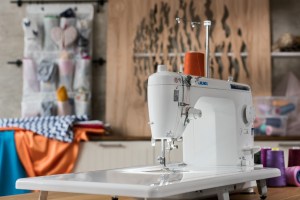
Prioritize tasks and break your sewing down into manageable steps! This allows you to focus on one project piece at a time, cutting fabric, sewing seams, or ironing. Remember to declutter and tidy your workspace to maintain a clear and inspiring workspace. By creating an efficient workflow tailored to your needs, you’ll be able to fully immerse yourself in your sewing and quilting projects, resulting in beautifully crafted creations!

Inspiring and Personalized Decor:

Create an inspiring environment in your sewing room by adding personal touches and decorative elements. Display finished projects, hang inspirational quotes, or place around artwork that sparks your creativity. Look into incorporating good lighting to avoid eye strain during your project creation. Maybe add a pinboard or corkboard to pin inspiration, project ideas, or fabric swatches!

A well-organized sewing room is a haven for creativity and productivity. By implementing the tips and tricks in this blog post, you can create a functional and inspiring workspace that enhances your sewing experience. From efficient fabric storage to optimizing workflow and adding personal touches, these strategies will help you maximize your sewing space and enjoy a clutter-free environment. Embrace the joy of organization and watch your sewing projects flourish in a space designed for creativity and efficiency. Happy sewing!

National Account Spotlight: Creating with Grome’s Sewing Center

Join us in meeting Hannah, daughter of Cyndi Grome, one of the operators of Grome’s Sewing Center located in Austin, Texas!

Keeping San Antonio in Stitches Since 1950 Grome’s Sewing Center is so passionate about helping sewists like you create their dream projects! At Grome’s Sewing Center, they want their customers to come in and feel welcomed to find the right machine for their needs, browse their machine accessories, choose your notions, and pick the perfect fabric for your designs. Follow along below as Hannah shares everything you should know before visiting!

Follow along below for the transcript version of our interview with Hanna from Grome’s Sewing Center.

Hi everyone I’m Hannah from Grome’s Sewing Machine Company in both San Antonio and Universal City Texas. Welcome!

Grome’s Sewing Machine Company is a family-owned and operated business that’s been running since 1950. My great great grandfather, Isador Grome, started Grome’s Sewing Machine Company with his son Lou Grome and then Lou brought in Richard my grandfather, and then my grandfather brought in my mom and my mom took over the business, brought in her sister Irma, and now I’m the fifth generation here at Grome’s Sewing Machine Company working here alongside my mother Cindy Grome.

What JUKI machines can a customer find at Grome’s Sewing Machine Company?

You can find a lot of great JUKI machines and accessories here at Grome’s Sewing Machine Company. We have your favorite quilting machines, like your J350, we even have the infamous TL series, which is great for bag makers and Quilters alike. We have the J150, the DX4000, DX3000 F600, so if there’s any JUKI machine that you need for your sewing needs you can come to Grome’s and you’ll know that you’ll be able to find exactly what you need. And our sales staff can help you fit into just the perfect machine for you.

We have a wide array of JUKI accessories like the JUKI quilting rulers, as well as all of the JUKI feet, and we have the extension tables, we have the thread stands, so whatever accessory that you’re looking for Grome’s has it.

What are the benefits of being a Grome’s customer?

Purchasing from Grome’s has a great amount of benefits. Not only do we service your JUKI machines here in our store with certified technicians, and technicians who’ve gone to many dealer trainings and technician trainings to know how to work your machine inside and out; we also do in-person classes. So when you purchase your machine from us we can sit down with you, make sure you know how to thread your machine, wind a bobbin, and we have classes where you can learn how to use all the decorative functions of your machine as well. It’s a really great deal!

What can customers expect to find while shopping at Grome’s?

As you can see behind me we have a beautiful selection of fabrics in-house. We also have all of your quilting, sewing, and embroidery notions. We have everything that you need to finish your products. We have all of the amazing threads that you’re going to want, we have quilting threads, embroidery threads, general sewing threads, stretch cover lock threads, serger threads, everything you can think of.

We have kits that we make here in-house as well for all of your fun projects. If you want like a three-yard fabric project we got it. If you want patterns, we got it. You want books? We got it. You want anything special order? Shoot! Give us a call, we can find it for you and try to order it. So Grome’s, we got so much and we’ve been doing this like I said for 73 years so if you’re talking about something you can rest assured we know what you’re looking for and we can help you find it.

What makes Grome’s unique?

One of the best and most unique things about Grome’s Sewing Machine Company is that we are a family business that has been passed down generation through generation. We know the ins and outs of sewing machines all the way back from when my great grandfather brought the first zigzag sewing machine to the San Antonio area from Europe. So when it comes to knowledge base we’ve got my mom, I don’t know how she does it, but she can just pull up parts out of her head like a crazy person! But she’s amazing and we have the family support and knowledge base to help you figure out if you’re having issues with your machine, we can walk you through it, we can help you solve problems, we have techniques that we’ve known because we all work together here. You know I may be the fifth generation, the youngest here, but I always bring a fun and new modern twist to maybe some of the more contemporary things that my mom brings to our table. So we’re a fun family here that has a knowledge base that just kind of blends together and helps to help you create all your beautiful projects on your JUKI machines.

Does Grome’s have a message for future customers?

Grome’s is a great place in our community to come together and sew with each other, create projects, find all of the items that you need to create your amazing beautiful designs and ideas. We are always having great classes, with great instructors and we have events all throughout the year that we just keep scheduling and scheduling and scheduling and it’s a lot of fun. We do our best to try to get the entire community involved with the multiple events that we have throughout the year. We’re always running you know sales and having just a fun time together. I mean that’s what the sewing industry is about, it’s an art, we like to have fun and create.

We would be so honored if you would come to visit us here at Grome’s or even shop with us online. We are doing so much to grow our business here in the next few years and we would love for you to join our journey and we hope to see you soon. On our social media pages we have our Facebook at Grome’s Sewing Machine or Instagram at Grome’s Sewing. We have our YouTube at Grome’s Sewing and we’re always just trying to do our best to put out so much content for you because this is what it’s all about, is serving you all and creating your JUKI projects with your JUKI machines and helping you to create even more beautiful designs, ideas, quilts, and project garments and all of such. So we look forward to seeing you soon visiting us at Grome’s Sewing Machine Company, thank you!

To learn more about Grome’s Sewing Center, visit their website here! Thank you for joining us today in getting to know Hannah from Grome’s Sewing Center. We hope you get a chance to visit the next time you’re in the area!

Facebookhttps://www.facebook.com/GromesSewingMachine

Instagramhttps://www.instagram.com/gromessewing/

YouTube:https://www.youtube.com/@gromessewing

Websitehttps://www.gromes.com/

National Account Spotlight: Introducing Premier Stitching!

Join us in meeting Faith, one of the operators of Premier Stitching located in Bryan, Texas!

As one of the largest sewing machine dealers in America, and with 25 years of business under their belt, Premier Stitching offers most major brands like your favorite JUKI, and a large selection of tools, notions, accessories, and fabrics for your project plans. They offer repair services, online ordering and shipping, one on one teaching and so much more! Watch below as Faith covers everything you need to know before visiting their shop.

Follow along below for the transcript version of our interview with Faith, one of the operators of Premier Stitching.

Hi, I’m Faith, and I work at Premier Stitching. We are a sewing and quilting shop here in Bryan, Texas, and we were primarily online before, but back in January, we just opened our brick-and-mortar store!

So history started with my grandpa in the 70s. He owned Singer stores, and in 87′ he decided to open his own store and run the kinds of machines he sold and who he could sell to. So then, in 99′ when my dad was working with him, they decided to start the online business, and it was called SewVacDriect, and just back in January, we actually changed our name to Premier Stitching because we stopped selling vacuums a while ago, and people would you know, ask us for vacuums all the time but we wanted to focus on the Premier Products that we sell, the quality, the customer service, and everything. We just wanted to make our name what we’re focused on.

What JUKI Machines can customers find at Premier Stitching?

So we do sell almost all the JUKI machines. In our store, we do sell all of the home machines, and online, we do have all the home machines, as well as the industrial machines, available. So if you want an industrial machine or information, you would need to go on our website, and you could call us for information. For home machines, also on our website or in our store. Accessories, we have all the accessories at our store and available on our website.

What can customers expect while shopping at Premier Stitching?

Shopping at Premier Stitching, you can expect excellent in-house customer service, on-site authorized repair technicians, a wide range of classes, and you can always trust that we will do our best to get you what you need and at the best price.

What classes are provided at Premier Stitching?

We created a class specifically for homeschool students so that they can learn how to sew, and we have one semester for beginners and we also offer a semester class for intermediate. We also have beginner sewing classes for adults and children, as well we also do summer camps for adults and children. We also have a multitude of other classes available and the calendar is on our website.

How can customers contact Premier Stitching?

If you’re ever in Bryan, stop by. We have a multitude of items that are exclusively available in our store; such as fabric, threads and notions. If you want to get in touch with us, you can visit us at our store in Bryan, located at 700 South Bryan Avenue or you can give us a call at 800-229-889 or visit us on our website, http://www.premierestitching.com.

To learn more about Premier Stitching, visit their website here! Thank you for joining us today in getting to know Faith, one of the operators of Premier Stitching. We hope you get a chance to visit the next time you’re in the area!

National Account Spotlight: Visiting McDougal Sewing Center

Join us in meeting Dan and Karen Welch, owners and operators of McDougal Sewing Center located in Katy, Texas!

With 4,000 sq. ft. in their main store and five stores located within Jo-Ann Stores, Dan and Karen have worked hard to honor Bob McDougal’s, Dan’s grandfather’s, legacy. Striving to introduce the newest in sewing and embroidery innovation to their customers, join us below to learn more about the products, expertise, and instruction available at their shops today!

Follow along below for the transcript version of our interview with Dan and Karen Welch, owners of McDougal Sewing Center.

Hi, I’m Karen Welch with McDougall Sewing Center and I’m Dan Welch with McDougall Sewing Center as well. We’ve been in the business a long time. Why don’t you tell them the history of our business? The history of the business, my grandfather Bob McDougall, started the company in 1940. As a kid growing up I came in and messed all the machines up and I started full-time in 1976, so been in the business a few years and I worked with the family for 18 years before getting the blessing to use the biggest asset we have, which is the McDougall name, and was able to, with family support, use that name and Karen and I opened up out in Katy Texas in 1993 and we’ve been expanding and growing ever since.

She started with me full-time by 1995 so tell people I am the boss and I have her permission to say so. That’s correct, that’s correct. Basically, when we got married, we’ve been married since 1981 so 42 years, when we got married I asked if it is a prerequisite that I sew and he said oh no, well guess what, he lied. So I’ve been doing this a long time as well; so it was not my life’s work to do but it’s been a good life’s work.

When did McDougal start carrying JUKI machines?

We’ve had the JUKI’s for approximately, oh I don’t even know, about eight years, eight or nine years now. We’ve had the JUKI product and they work out of the box that’s the good thing with the JUKI product. When you open it up out of the box there’s no major or minor adjustments to be done it works out of the box.

What JUKI machines can a customer find at McDougal?

We sell the QVP series of the JUKI machine so they are sewing machines and sergers, and then, of course, we sell the eight-needle Sai and we’ve had good luck with them. They’ve been workhorses, they’ve been well received by our customers, so I think it’s been it’s been a good experience for us. And because we very seldom get complaints with JUKI and I will say that that’s one of the things that we like to promote is when you become a customer at McDougall’s and you purchase a machine from us you become a part of the McDougall family and you get what we call the McDougal advantage, and basically that’s going to be you get unlimited assistance, you get free scheduled classes, you get a one-year dealer warranty which includes a first-year free service and we’re here to support you so that’s part of it and we have authorized repair people so it’s been it’s been a good experience for us.

What benefits and extras does McDougal offer?

We do have a service technician that has been with us, he said it was 1981, so he’s been with us, the Bob McDougall company, and then with McDougall sewing center, he has been with us for 42 years so he’s our lead technician. Then we have two other technicians and they do a good job with keeping up and having the product available. We do, like Karen said, offer additional events and different programs, classes. I know we’ll take some video of different projects going on with using the machine and all the decorative stitches and all the optional accessories that are available. JUKI product is very good with coming with a full set of accessories however there’s more than one size of roll timber. For example, we stock those, there are literally a wall full of different accessories that we show you how to use and have classes, and you bring your machine in.

Our classes are hands-on, you come in and use the machine, use your machine, in our class so there isn’t any guesswork when you get home. You know how to make a quilt block using the different accessories and we have a class, where it is very popular that we repeat a lot, and it’s called foot fetish and it’s using all the accessories that comes with your machine. Rebecca Joseph, our lead educator, has been with us for four years, four or five years, since she and her husband came back from Saudi Arabia, their stent in Saudi Arabia, and she has always been in the sewing machine industry, as well her father was in the industry, and had numerous stores around the Houston metropolitan area as well.

What do you see for the future of Mcdougal?

The future of McDougall’s, Karen and I are getting up to the age where looking at you know what it would really love to be retired. However, we want to keep the family tradition going. We have two kids and they went different ways. We worked them pretty hard as kids, so they decided to go to other options. They wanted Saturday off and being in retail you just don’t get Saturdays off, you work, that’s you know most time that’s our busiest day. So the future of McDougall you know still looks bright, we have no plans of closing. We will be here to continue to support the end consumer and support our customers and employees as well.

How can customers contact McDougal Sewing Center>

There’s numerous ways that you can get in touch with us here at McDougall Sewing. We have an 800 number which is 800-FUN-2SEW we also put out a monthly flyer that has our specials for the month along with coupons you can check our website which is www.McDougalSewing.com and see all of the products that we offer, all the classes that we have, all the specials that we have, and the upcoming events. We have a lot of upcoming events, we try and do them at least two a quarter. We do have a Facebook page as well so we post pictures of all the classes that we have on our Facebook. So those are some ways that you can contact us and we would love to talk to you and have you come by and visit with us, you don’t have to buy anything you can just come say hi that’s fine we would love to have you come by!

Thank you!

To learn more about McDougal Sewing Center, visit their website here! Thank you for joining us today in getting to know Dan and Karen Welch, owners of McDougal Sewing Center. We hope you get a chance to visit the next time you’re in the area!

Instagram: https://www.instagram.com/mcdougalsewingcenter/

Facebook: https://www.facebook.com/mcdougalsewingcenter/

Know Your Needles with JUKI

When creating, you may wonder, what needle should I use on my machine and project? Today we will give you a lesson on needles and what you need to know before you start sewing your next idea. Understanding what needle you need will help you create without the mess of skipped stitches, a thread coming loose, a pucker in your fabric, and so much more. Let’s start from the bottom and work up to picking the right needle.

How do you read the needle size?

Depending on your fabric, you’ll want to find a needle that can puncture the fabric well but not tear it when you are sewing.

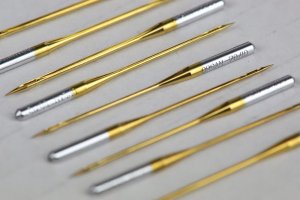
The needle size ranges from small to large, and each sewing machine needle will have two numbers etched onto it. Usually separated by a slash, these numbers determine whether it is a heavy-duty needle. 60/8, for example, is a lightweight needle suitable for cotton. At the same time, 90/14 is a heavyweight needle good for vinyl. 

Now what do those numbers mean exactly? The first number is measured in the European/Number Metric (NM)/International system, for example, the 60 in 60/8. The metric number usually increases by 5 or 10 when you need to size up your needle for heavier fabric. Home sewing machine needle’s most common metric size is between 60 and 130.

The second number is measured in the American/U.S./Singer/Imperial system, for example, the 8 in 60/8. For your home sewing machine, the most common imperial size needed is between 8 and 21, and the needle sizes usually increase by 1 or 2.

How do you choose the right needle?

There are a few brand options for sewing machine needles, but today we will discuss Organ needles. When choosing a needle, our best recommendation is to pick the smallest one possible for the fabric you’re working with. Needles will leave holes in your fabrics as it goes, so you want to minimize the view of them.

Now know you’ll need to find the right needle for your fabric, we’ve compiled a list of fabrics and the recommended organ needle size to use when creating.

Fine Fabric: Silk, chiffon, and lace

  • Silk 55/7; Microtex 60/8 and 70/10

Lightweight Fabric: Cotton or spandex

  • Universal 80/12; Jersey 70/10 or 75/11; Super Stretch 75/11

Medium-Weight Fabric: Linen, fleece, velvet

  • Universal 80/12 or 90/14; Jersey 90/14; Super Stretch 90/14

Heavyweight Fabric: Leather, canvas, denim

  • Jeans (blue shank) 90/14 and 100/16

Very Heavyweight Fabric: upholstery or heavy denim

  • Titanium 90/14; Jeans (blue shank) 110/18

For all needles, including Organ needles, these are things to keep in mind:

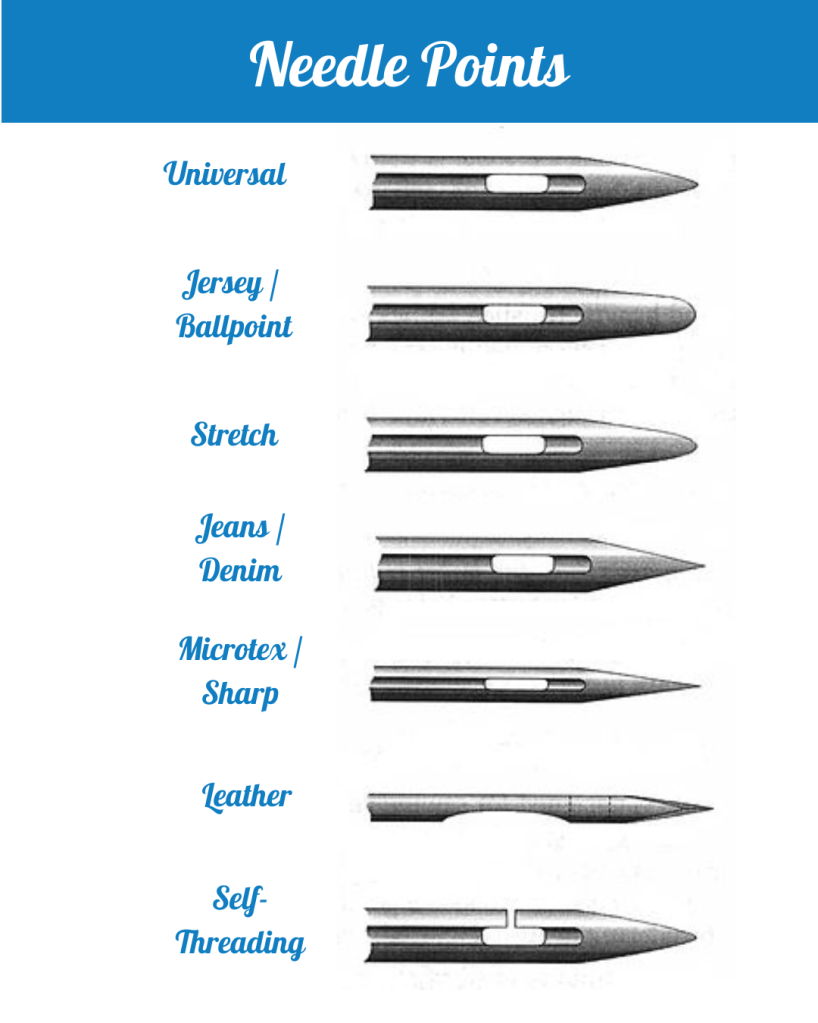
  • Universal Needle is the most commonly used needle on a home sewing machine. It can be used on woven fabrics, synthetics, and knit fabrics. A universal needle should use polyester, cotton, or silk threads.
  • Ball Point Needle: with a rounded tip on the needle, this is commonly used for rib knits, interlock, cotton knits, fleece, double knit, and most knit fabrics. This is because the ballpoint pushes the fabric fibers apart rather than cutting them, preventing stitch runs.
  • Stretch Needle: with a scarf tip, this needle allows the hook to pass by and prevent skipped stitches when working on fabrics like stretch knits, silk jerseys, or spandex.
  • Jean Needle: You might have noticed above that Organ recommends a jean needle when working on denim material; this is because the very sharp point on the Jean needle can handle that firm fabric and cleanly pierce through. You can also use this on heavy canvas fabric or home décor linens. This is a perfect moment to study your thread too! If you’re working with threads like 100% polyester or heavier top stitching threads, this needle will help you create easier.  
  • Sharp Needle: Quilters might know about this one. A sharp needle can penetrate through multiple layers of fabrics, like for quilting creations that involve several layers of cotton and padding. Helpful for preventing skipped stitches and needles breaking, a shark needle is an excellent needle to have no hand.
  • Quilting Needle: Quilters can also get the traditional quilter needles created for penetrating several layers of fabrics in projects. You will notice that quilter needles are a little shorter than Sharp needles. Choose the best needle size for your needs!

Remember, the thread you’re using for your sewing project will also determine the type of needle you choose! For example, if you’re creating with a fine thread, you’ll want to use a small needle size to reduce the thread from falling out the eye of the needle. Also, remember that the lighter the fabric, the smaller the needle size, and the heavier the fabric, the larger the needle size.

We hope this helps you create your next project as you use the right needle on your creation! To learn more about Organ needles, visit here.