JUKI Tip: Double Fold Bias Binder Overview

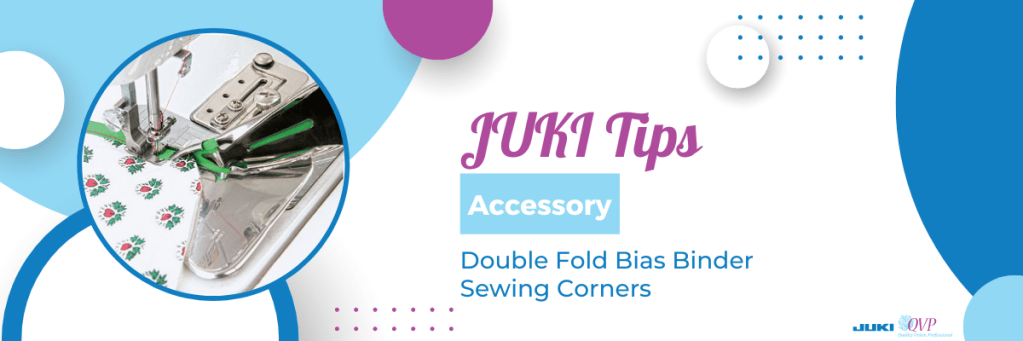
On this JUKI tip, we use the Double Fold Bias Binder and show you how to feed the fabric into the machine with this accessory and create a smooth sewing experience!

Follow along below for a rundown of what Alba covers on today’s JUKI Tip!

Hi, friends my name is Alba and I would like to welcome you to another tips and tricks with JUKI! Today I am talking about the double-fold bias binder and I have two sets in this video; one is a 38-millimeter and one is a 32-millimeter. The one I have on my machine is the wider of the two and I want to show you what exactly is in the package when you open this up.

I am going to open it right in front of you and I am going to pull out the binder itself and it comes with fabric and binding on it. It also comes with a little package with a thumb screw and a foot, and it comes with an instruction sheet. So what I wanted to show you is a little bit of detail, of what is in this, and as I said the one that’s on the machine is a 38-millimeter one, and what that means is how wide the fabric is that is put into the binder and how wide the finished product will come out.

For the 38-millimeter one, I used a one and a half inch strip of fabric, folded it and the completed bias is about 3/8 of an inch. Now what I like about this is you’re going to notice how short that foot is and this is really helpful as you’re sewing because that binder can get really close to the foot and allows for very little movement and of course we have our thumb screws to be able to put this onto the machine. Now what most people get confused with is they’re expecting this portion here to lay flat on the machine but as you can see in the video this accessory rests off of the machine. The thumb screw goes into the screw hole that’s on the bed of the machine, so these are intended for the industrial machines and the machines with solid metal beds, so that they could get screwed directly into the machine and a lot of people do not realize that pivot action that this attachment has.

Now I have two pieces of fabric and both of them have been cut to one and a half inches, and I’m going to show you the struggle that most people have and my tip for feeding the fabric into the machine and getting this to run smoothly. Now most people try to feed the fabric with it in the position right in front of the foot, but if you pivot this, it allows you to better see, getting that fabric in there and just puts you in a much better angle. Now as you’re noticing, I have the wrong side of the fabric facing me. Where most people have an issue is right there and I’m gonna get recommend a stylus, and with that tip, the fabric needs to go underneath its section in the video. Now this is where a lot of people have trouble trying to do that and I’m going to give you my tip for getting that done.

Now let me pull my trusty scissor out and I am going to cut a point into my fabric. By putting a point into that fabric, and you definitely want to use a stiletto, look at how easily that goes right into that fold. And as I pull this out I want to make sure that my fabric is folded, and what I do is I give this a little bit of a finger press. Now when I lift my foot and lift my needle I can move that fabric right underneath the foot and that large thumb screw will allow you to move this right and left so that when you lower your foot. Your needle is just slightly off of that edge to top stitch that edge. Now as I cut this, it was the width of fabric, and I am going to just sew away. Now watch in the video how even at that full speed, how brilliantly and effortlessly that works because this attachment is right up to the foot.

Now I am showing you sewing these pieces shut. I’m going to do a video really soon on putting um this into a quilt sandwich, and doing that mitered corner, but I wanted to show you this finished product and also some of the crafty things that you can do with these strips. You might have noticed my lanyard and I really like fun bright colors so I made my lanyard with the strip, and I happen to have made it so that it can hold my little scissors but also weaving fabric and doing that repeatedly so that you can create your own fabric and your own patterns, how cute would that be as an inset for a waistline? Or for a garment, for a tote bag. I want you to Google and search YouTube videos for fabric weaving to see all of the different things that you could do with that. I want you to stay tuned for another video that I will be doing on mitering corners and using this on quilt fabric.

Thank you for coming and sharing your time with me, what do you want to see next on JUKI tips? Lets us know down below!

Know Your Needles with JUKI

When creating, you may wonder, what needle should I use on my machine and project? Today we will give you a lesson on needles and what you need to know before you start sewing your next idea. Understanding what needle you need will help you create without the mess of skipped stitches, a thread coming loose, a pucker in your fabric, and so much more. Let’s start from the bottom and work up to picking the right needle.

How do you read the needle size?

Depending on your fabric, you’ll want to find a needle that can puncture the fabric well but not tear it when you are sewing.

The needle size ranges from small to large, and each sewing machine needle will have two numbers etched onto it. Usually separated by a slash, these numbers determine whether it is a heavy-duty needle. 60/8, for example, is a lightweight needle suitable for cotton. At the same time, 90/14 is a heavyweight needle good for vinyl. 

Now what do those numbers mean exactly? The first number is measured in the European/Number Metric (NM)/International system, for example, the 60 in 60/8. The metric number usually increases by 5 or 10 when you need to size up your needle for heavier fabric. Home sewing machine needle’s most common metric size is between 60 and 130.

The second number is measured in the American/U.S./Singer/Imperial system, for example, the 8 in 60/8. For your home sewing machine, the most common imperial size needed is between 8 and 21, and the needle sizes usually increase by 1 or 2.

How do you choose the right needle?

There are a few brand options for sewing machine needles, but today we will discuss Organ needles. When choosing a needle, our best recommendation is to pick the smallest one possible for the fabric you’re working with. Needles will leave holes in your fabrics as it goes, so you want to minimize the view of them.

Now know you’ll need to find the right needle for your fabric, we’ve compiled a list of fabrics and the recommended organ needle size to use when creating.

Fine Fabric: Silk, chiffon, and lace

  • Silk 55/7; Microtex 60/8 and 70/10

Lightweight Fabric: Cotton or spandex

  • Universal 80/12; Jersey 70/10 or 75/11; Super Stretch 75/11

Medium-Weight Fabric: Linen, fleece, velvet

  • Universal 80/12 or 90/14; Jersey 90/14; Super Stretch 90/14

Heavyweight Fabric: Leather, canvas, denim

  • Jeans (blue shank) 90/14 and 100/16

Very Heavyweight Fabric: upholstery or heavy denim

  • Titanium 90/14; Jeans (blue shank) 110/18

For all needles, including Organ needles, these are things to keep in mind:

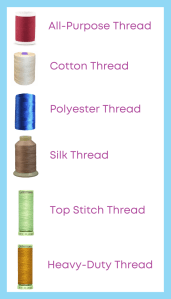
  • Universal Needle is the most commonly used needle on a home sewing machine. It can be used on woven fabrics, synthetics, and knit fabrics. A universal needle should use polyester, cotton, or silk threads.
  • Ball Point Needle: with a rounded tip on the needle, this is commonly used for rib knits, interlock, cotton knits, fleece, double knit, and most knit fabrics. This is because the ballpoint pushes the fabric fibers apart rather than cutting them, preventing stitch runs.
  • Stretch Needle: with a scarf tip, this needle allows the hook to pass by and prevent skipped stitches when working on fabrics like stretch knits, silk jerseys, or spandex.
  • Jean Needle: You might have noticed above that Organ recommends a jean needle when working on denim material; this is because the very sharp point on the Jean needle can handle that firm fabric and cleanly pierce through. You can also use this on heavy canvas fabric or home décor linens. This is a perfect moment to study your thread too! If you’re working with threads like 100% polyester or heavier top stitching threads, this needle will help you create easier.  
  • Sharp Needle: Quilters might know about this one. A sharp needle can penetrate through multiple layers of fabrics, like for quilting creations that involve several layers of cotton and padding. Helpful for preventing skipped stitches and needles breaking, a shark needle is an excellent needle to have no hand.
  • Quilting Needle: Quilters can also get the traditional quilter needles created for penetrating several layers of fabrics in projects. You will notice that quilter needles are a little shorter than Sharp needles. Choose the best needle size for your needs!

Remember, the thread you’re using for your sewing project will also determine the type of needle you choose! For example, if you’re creating with a fine thread, you’ll want to use a small needle size to reduce the thread from falling out the eye of the needle. Also, remember that the lighter the fabric, the smaller the needle size, and the heavier the fabric, the larger the needle size.

We hope this helps you create your next project as you use the right needle on your creation! To learn more about Organ needles, visit here.

National Account Spotlight: Come Down To The Sewing Machine Shop

Join us in meeting Dan Schoenberg, one of the owners of The Sewing Machine Shop located in the greater bay area of California!

Offering creators like you the full JUKI Line, sewing accessories, notions, and more, The Sewing Machine Shop is ready to help you find the right machine for your next dream project.

Follow along below for the transcript version of our interview with Dan Schoenberg, one of the owners of The Sewing Machine Shop.

Hi, my name is Daniel Schoenberg I’m the owner of the sewing machine shop here in Walnut Creek California. We’ve been in business for 35 years and we specialize in the sales and service of household and Industrial sewing machines. We carry a lot of related accessories and supplies like thread and needles presser feet scissors etc. and yeah that’s about it. That’s what we do; we don’t do vacuum cleaners, we don’t do alternative appliances, we’re just sewing machines only.

What Inspired You To Open The Sewing Machine Shop?

I actually started out of college; my older brother was a commercial sewing machine technician and he wanted to start a shop when I finished College. He gave me a job offer and the rest is history. We started in 1987 and have been growing ever since.

Why Do Customers Love Visiting The Sewing Machine Shop?

We have a very good reputation now built up over many years. We carry a variety of sewing machines, different brands, models, types; so everyone can come and sew on these machines and compare models with a fairly unbiased view of what we like.

What Machines Can A Customer Find At Your Shop?

When customers come here, first they’ll see that big selection of machines. We carry four different brands, and they can get machines from as little as 200 going all the way up to our top-of-the-line machines in excess of fifteen thousand dollars. We carry a lot of specialty machines; we carry long arm quilting machines like you see here on the right, and we carry embroidery machines, multi-needle, for commercial and semi-commercial use. We have a very very good staff here that are all accomplished sewers themselves so when you get a demonstration on machines you’ll be able to get a professional opinion and you’ll be able to ask all your questions that you have, all your concerns should be answered very honestly and straightforward.

What Are The Benefits Of Being A Customer?

So once a person purchases a machine from us they’ll get great service beyond the sale. We have extensive classes, usage classes to learn how to use the machine, all the way up to more advanced classes to learn how to create garments, create quilts. We have three full-time technicians here so we do a lot of servicing and repair work, including any warranty work that our customers might need, and customers can just drop in sometimes anytime for minor things like fixing a needle threader. We can diagnose the machine in front of them many times, we can get them going right away, we don’t need them to leave their machine if it’s something simple that we can fix on the spot and many times we don’t even charge any money for that

Why Did You Start Carrying JUKI Machines?

Yeah, we started carrying JUKI machines many years ago. We started even before they introduced a full domestic multi-stitch machine. So the machines we focused on with JUKI were the machines that bridge the gap between household sewing and Commercial sewing. Our most popular JUKI machine is their TL series, which they’ve had for many years, and that is a semi-industrial straight stitch only machine that can sew quite high speeds up to 15 – 1600 stitches per minute. It can take all standard, common industrial sewing machine accessories and it’s a huge seller among not only our quilting Quilters who like speed and a larger throat area, but our garment sewers, and tailors, and dressmakers, and designers as well.

What Makes The Sewing Machine Shop Unique?

I think what makes The Sewing Machine Shop unique is our staff and our people and the vast knowledge that we combine as a group. So between me and the rest of our technicians from the technical side, we’re talking about about a 100 years combined of experience working on machines, and our staff we have another, I would say another 100 years of combined sewing experience. Whether it’s quilting or garment making, or embroidery which is a big aspect of what we do, so I think the selection of the machines having five different brands that you can compare side by side combined with our staff with a vast experience is what sets us apart from other sewing machine dealers.

Having a place where you can actually try the machines before you buy the machines in a no-pressure environment is a very important thing, especially now with the internet and being able to buy so many things online and not getting to touch it, to try it, to listen to the sound of the machine, to ask all your questions in real time; I think that is what I would like to express my customers.

Come into the shop and just take a look around. Talk to our staff, just browse, sew on the machines if you want; if you don’t want to that’s okay too, see what supplies and accessories and notions we have here so the next time you’re in need of anything that has to do with sewing or sewing machines you’ll know what we offer.

How Can We Contact The Sewing Machine Shop?

thanks for listening to this video and I just invite everyone to come on down to the sewing machine shop the best way to really stay in touch with us is to go to our website sewing machine shop.com and you can sign up for our newsletter and our email on our email list um you can also follow us on Facebook but I think we’re sending out weekly informational articles promotions future classes and events so uh go to sewing machineshop.com sign up for our email list and you’ll be able to stay in touch with us

To learn more about The Sewing Machine Shop, visit their website here! Thank you for joining us today in getting to know RDan Schoenberg, one of the owners of The Sewing Machine Shop. We hope you get a chance to visit the next time you’re in the area!