
How to Self-Publish Your Pattern Book

Do you remember the first time you created a sewing pattern? Have you sold one yet? Pattern creation in sewing and quilting is a skill that many learn to love and participate in. Whether they’re creating quilts or their closet, pattern creation allows you the freedom to truly form an idea straight from your mind. Once others start noticing our designs and appreciating the final project, we may decide it’s time to start selling these patterns. But how do you publish and sell a pattern book?

While there are many ways to go about being published; agents, publishing houses, and book deals, we now have the option to self-publish our books thanks to the internet. Today we’re going to talk about how you can self-publish your pattern book right from home, using the right tools.

Creating Your Pattern Book

Let’s start with your pattern book. If you’re reading this, you most likely already know how to create a pattern, so let’s break down turning this into a pattern book.

  1. Create a Theme and Outline

Before starting this journey, sit down and decide what type of patterns you’ll be focusing on (quilts, child apparel, workout apparel, etc.) From there begin drafting an outline of how you would like your book to flow.

  • Assign Yourself Writing Time

When it comes to creating a book, whether it’s fiction or patterns, it can be time-consuming! Make sure to set aside time in your days so that you can focus on writing your patterns. Our best tip? Set yourself an end goal date for the best results. 

  • Ask For Help

When writing your first pattern book, it’s best to have outside assistance proofreading your work, testing your patterns, and confirming the flow of the book is understandable to the skill level you’re marketing to. For example, if your pattern book is geared towards beginners, we recommend being detailed in the little things.

Finding Your Front Cover and Book Design
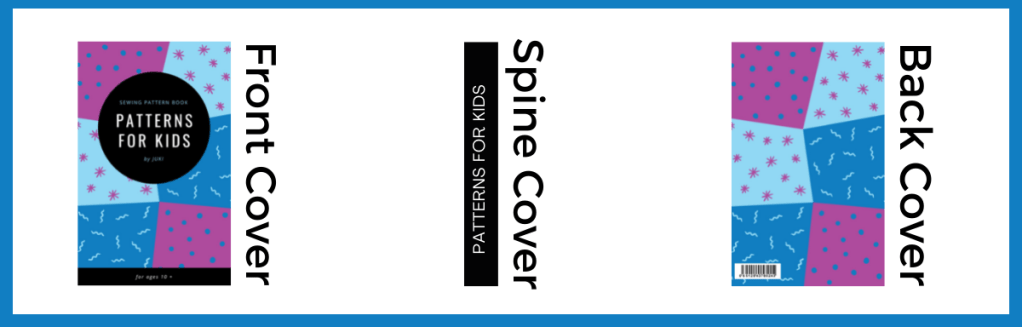
Most people will judge a book by its cover, so make sure that your cover is eye-catching and true to your pattern designs. Self-publishing books still compete with other booksellers, and you want your book to garner attention.

Some will be able to create their front covers, but for those who want a more professional design, there are websites that allow you to hire creative designers for affordable prices. If you choose to design your front cover, here are some tips to keep in mind:

1. Research other pattern books and review the designs that grab your attention. Decide what works best, and what you find eye-catching, and think about how you can create a cover that will draw attention to your work.

2. Remember, your work will be sold online as a self-publisher, so the graphics used to sell your book will be minuscule. Keep this in mind when designing your cover so that you stay away from designs too busy, as that would make the image difficult to see, or using small details that would be overlooked as a thumbnail image.

3. Choose a title font that is legible for viewing and easy reading and a title that is eye-catching and captures your work well.

4. Don’t forget the spine and back cover! While not seen during online shopping, customers will see this after purchasing and we want to make sure the whole design is complete and follows your front cover.

If you choose to design your book, below are a few design programs you can consider using:

–         Adobe InDesign

–         Canva

–         Affinity Publisher

–         Shutterstock Editor

If you choose to hire a designer for your book, below are a few sites we recommend checking out that offer designers for hire.

–         Fiverr

–         Guru

–         Reedsy

–         Upwork

How and Where To Publish

The next step is thinking about how you want to sell your books. Depending on how you choose to publish, this will affect your channels of distribution and the format you sell in.
Print on Demand

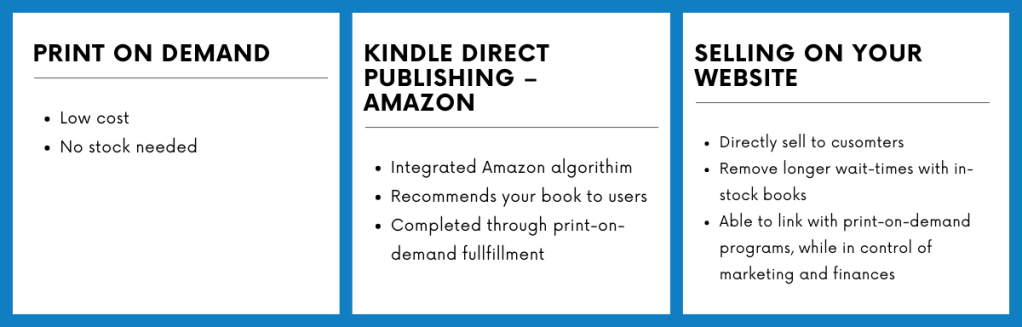
A concept used by self-publishers due to its low cost, this publishing idea allows you to print books when purchased and removes the aspect of creating copies and stocking them. For example, ‘Lulu Direct’ is a self-publishing platform for printing and distributing books with a large style selection you can choose from to personalize. For other platforms, you can check out Acutrack and Blurb.

Kindle Direct Publishing – Amazon

Amazon’s self-publishing platform has seen a rise in popularity due to the ease readers enjoy while using its platform. With over 50% of the printed book market being sold by Amazon, your book has a high chance of being viewed thanks to the Amazon algorithm. Using reader’s recommendations, your book will be placed in front of new customers without your assistance.

The way amazons self-publishing works is through print-on-demand fulfillment and the option for e-book sales. E-book sales must be exclusive to Amazon if sold on their platform, but physical books are free to be sold on their site and anywhere else. Amazon will handle printing and shipping, with a percentage of royalty credited to the creator. 

Selling on Your Website

If you have a website for your business, you can link your account with a program like ‘Lulu’ to begin directly selling books to customers. By integrating Lulu and a website platform like Shopify, you can sell print-on-demand books and control your shop sales and marketing with Shopify.

Another option is buying your pattern book in bulk from a print-on-demand publication and selling it from inventory on your site. This option is best for offering faster delivery instead of having a multiple-day wait time for printing.

Formatting Your Book

Once you’ve decided how and where you’re going to sell your new pattern book, let’s cover the formatting aspect. Depending on the platform you use for publishing, this will affect how you will format your book.

For example, if you choose to use Amazon’s platform they require you to create two different format downloads for sales. One is the manuscript, the manuscript must include all the pages inside your book. Next is the cover, this file will include the design covers you’ve completed for the front, back and spine of the book.

Make sure when creating your format for the pattern book you mind the margins and trim of your work. Depending on what book size you choose to publish in, make sure your book measurements transfer correctly before printing.

To start, place an introduction, cover the chapter/section breakdowns, go over the symbols you’ll use in your pattern book, and cover key details the reader should mind.

If you choose to section off your books, for example by designs, seasons, or projects, make sure to create distinct chapter marks for sewists to follow along and easily find the pattern they’re looking for. Creating a pattern book that is easy to read through will allow sewist to enjoy your work best.

Launching Your Pattern Book

Like any other product you’d sell, it’s time to start marketing and planning your selling space! Below are the steps you should take before launching your book.

  1. Make sure your channels of sale work

Confirm that your program is in working order and receiving payments. Run a ‘test purchase’ and go through the site like a buyer, even purchasing a book if you’re working through print on demand. This is a great way to confirm your sale process is in order and will work for future sales.

  • Setup your website

If you don’t already have a website for yourself, make sure to get a basic one up and running! Think of your website as a ‘home’ for all your sales, products, and yourself. Here is where you will lead your social media channels and sales, to create a customer base and audience. This will make it easier for customers to get to know you.

  • Create an email marketing list

Building an audience isn’t easy, but one of the best ways to do this is through email marketing. Through this platform, customers can keep an eye out for future book projects, updates, and patterns. We recommend setting up a sign-up that allows visitors and customers to place their emails for your records.

  • Use an analytics tool

Last, but not least, keep an eye on your analytics! Website and storefront analytics is the best way to understand your audience, customers, sales, marketing goals, and more. Programs like Shopify come with a built-in analytics program, but Google Analytics is free to use and available for all.

Market and Sell Your Book!

Once you’ve created your pattern book, set up and tested your shop, and planned your marketing and website, you can begin getting your book out there! To help you find your customers, we’ve created a list of marketing ideas you can use for your new pattern book.

  1. Share excerpts from your pattern book. Whether it’s one free pattern to bring in interest, or a section where you dive into a technique, showcasing what people can have and learn is an amazing use of attention-grabbing.
  2. Encourage reviews! Reviews will bring attention to your books, and assist in sales since this will assist the algorithm in recommending your product to other customers.
  3. Social media ad campaigns are exciting! Whether you decide to use Facebook, Instagram, or Pinterest, these campaigns can help you get in front of the right audience. Keep in mind that social media campaigns come at a cost, so we recommend setting aside some money for social media ad work if you choose this route.
  4. Network and get your name out there! Whether you co-host podcasts, jump in on blog and forum spaces, or work with another sewist, bringing attention to yourself and your brand through word of mouth and others is a great way to build your credibility and expand your audience.

Need help creating a marketing plan? Visit us here to learn how to write a marketing plan today.

Keep It Going

You’ve now published your first book! The best plan is to keep promoting yourself and working on your patterns. As you enjoy the journey of creating and publishing pattern books, continue focusing on your marketing strategies, sales analytics, and building your profile and website.

Don’t be discouraged if you don’t see rocket sales when you first launch, as these types of things take time! As you continue to work on your patterns and skills, you’ll find yourself gaining a deeper understanding of the business aspect of it all. We hope this inspires you to publish your pattern book! If you created a pattern book, what type of patterns would you focus on? Let us know in the comments below!
JUKI Small Business Seminar: Setting Up Your Logistics

You’ve finally started your small business and have a product ready to be sold, your website should be up and running, your budget and finances should be in order, and you have those customers prepared to buy. Now that you have a start-up, let’s discuss getting your product to the customer!

Logistics is how you move materials, components, and products between your suppliers, storage locations, and customers. There are three things you should keep in mind as a seller: speed of delivery, stock of a product, and logistics cost. So let’s dive into your business and review how you create your products and how you’re getting them to the customer.

Lead Times and You

When your business begins to grow in sales, you might be reconstructing your process on where you buy supplies. Buying supplies at your local craft store for a business can be pricey, and when your sales reach a larger scale, it’s not cost-effective anymore.

When you begin to set up your logistics, consider critical lead times. For example, how long will it take for a customer to review your product, how long will it take to process an order and ship it, and how long will it take for you to receive the supplies you need for your product? Asking yourself these questions can help you plan for the cost and speed of your orders and shipments.

Knowing the lead time on the processes in your business will allow you to have smoother communication and expectation within your business and with the customer.

Shipping Carriers

When it comes to your process, shipping time to your customers should be a priority, especially in today’s society we’re shipping the same day, and overnight has become the norm. Because of this, shipping companies will work with small businesses by assisting them in maintaining good relationships with their customers and offering reasonable rates. You can also inquire about assistance provided for small businesses like logistical assistance and managing inventory. Here are the top 5 shipping companies we recommend for small businesses.

  1. United States Postal Service
  2. Sendle
  3. UPS
  4. DHL
  5. FEDEX

United States Postal Service

Ships goods both domestically and internationally, offers discounts and loyalty credits to small businesses, and delivers goods within 2–8 days on average. In addition, it provides free application programming interfaces (APIs) that allow small businesses to add shipping tools to their websites easily.

USPS shipping costs vary based on package size, delivery location, and delivery speed.

TIP: Deliveries on Sundays and holidays typically come with an added cost.

Sendle

An Australia-based small business shipping company, Sendle is best for small packages because it guarantees the best price for domestic packages up to 20 pounds. Shipping is 100% carbon neutral, and there are no subscriptions or contracts involved. They are well known for beating the price charged by major carriers for packages under 20 pounds.

TIP: packages cannot pass 20 pounds, and international shipping is unavailable.

UPS

If you ship large products, UPS will be the best option for you. They offer competitive rates (large flat rate boxes start at $18.40) and have resources for small companies that can assist in preparing your packages and information on palletizing your products if needed. They also offer same-day delivery in some cases.

Small businesses can get discounted pricing from UPS, with shipping incentives ranging from 20% to 50%, depending on the desired shipping speed and the small business’s average weekly shipping volume.

TIP: Some APIs, application programming interfaces, can’t be used on customer-facing websites.

DHL

If your business has taken you overseas, DHL Express is the best for those international shipments. They have a long-lasting history in international shipping and offer resources for small businesses that engage in global trading.

Costs vary widely based on your package’s size, whether it’s an import or export, the shipping speed, surcharges, and any optional services you choose.

TIP: DHL is known for many surcharges and optional service fees, so keep a close eye on your shipping agreement to avoid cost surprises.

FEDEX

FedEx is known for everyday shipping, even weekends, which means your product is delivered faster. FedEx can assist in shipments domestically and internationally and has a shorter lead time than others. Shipments in the US are usually 1-5 days and 3-7 for Alaska and Hawaii.

Small businesses can also benefit from their small business program, offering discounts on shipping, printing, money management tools, and more. They also provide a yearly contest where small businesses can win funds.

CON: Small package shipping costs are higher than USPS. However, they can arrive faster.

Packaging

When it’s time to package, we know how important it is that your product arrives to the customer safe and on time. The first step to completing that goal is ensuring you have the suitable packaging material for your product. One of the things to keep in mind before buying your material is knowing that purchasing in bulk will save you money down the line and is worth the investment. So follow along as we share the top things you’ll need for your packaging process.

Boxes and Mailers

Begin with deciding how you’re going to ship your product to the customer. The most popular options are boxes and mailers.

Cardboard boxes can offer the best protection for many products. Whether your product is a perfect square or an odd-shaped size, a cardboard box with the correct dimensions is an excellent choice for shipping purposes. You can choose to personalize these boxes and find them in different styles, colors, and sizes. These can be bulked orders or found at your local shipping store.

Mailers are great for small or flat products and less prone to damage. You can personalize these to your company’s brand, like cardboard boxes, coming in various colors, styles, and sizes. You can also choose to purchase mailers that come with a form of protection, whether this is internal cushioning or outer material that can handle bad weather.

Depending on your products, you can choose to keep an assortment of shipping materials available to use. However, keep in mind your product when purchasing shipping material to not waste funds on unnecessary boxes or mailers.

Cushioning and Filler

Keep your items safe and secure by purchasing cushioning and filler material. When shipping, these are crucial key material pieces as you want the product to arrive to the customer exactly how it left you.

Cushioning material is used for fragile items like glass, porcelain, or ceramic. Think of bubble wrap, foam peanuts, paper as options to keep the product from shattering or breaking in its packaging.

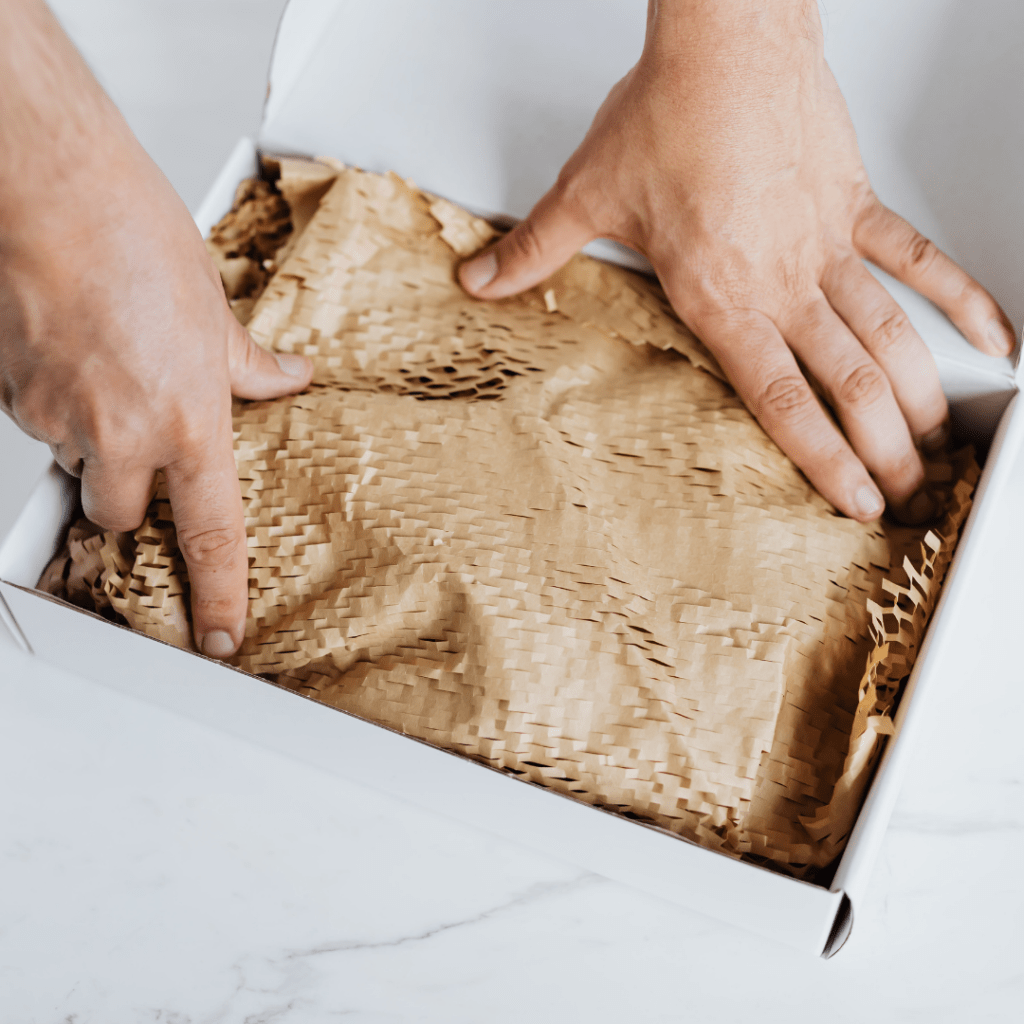
Void Filler can be used for any product. With material options like craft paper, air pillows, shredded paper, and others, these pieces of material will keep the item from moving around or crashing into each other if you’re sending more than one product at a time.

Keep these materials on hand at all times, as you wouldn’t want to ship products out without some filler to avoid broken or chipped products on arrival.

Labeling and Tape

Once your package is well prepared and safe to be closed up, you’ll need to seal and address it before shipping. Using quality tape and labels is the best way to confirm your product arrives to the correct customer on time and safely.

You can even create personalized packaging tape to stand out from competitors since packaging tape comes in various colors and sizes. Having suitable tape will save your product from accidents in the shipment process. You can also choose to invest in a tape dispenser if your company sees a pickup in shipments, which can help the processing speed.

Labels are also created in different sizes and styles. Used mainly for addressing the customer, make sure to use good labels to ensure it won’t fall off in transport. Labels can also include your company logo, specialty stickers like “handle with care” and more. Keep in mind that you can personally create these labels and style them to fit your product and small business.

Get Ready to Ship!

Now that you have the basic information for shipping and handling logistics for your small business think of ways to make yourself stand out. Packaging and shipping don’t need to be boring and can be another way your company stands out from competitors!

Look into eco-friendly merchandise for shipping and packaging. Include thank you letters, promos, or small freebies to induce excitement and customer loyalty. Create an unboxing experience for customers by creating a process that showcases your brand when opening a package from you, like wrapped apparel in tissue paper with a sticker to open the merchandise.

Your package is a window into your business for customers, so make sure to focus on your packaging like you would your product!

JUKI Small Business Seminar: Creating Customer Loyalty 

It’s great to get new customers and introduce your brand to new people, but one of the best ways to succeed is to create those returning customers. You can cultivate the relationship from the first time they purchase and continue it through social media and other channels.

One of the ways you can do this is by GLUE marketing, a strategy we’ll dive into in this article, where you ‘Give Little Unexpected Extras’ to customers during their experience with you and help them feel a sense of gratitude. By going just a bit above your competitors with this tactic, you can build closer relationships with each sale. GLUE doesn’t have to break the bank but can be a small thank you note, freebie minis of your product, or fun advertising products like stickers.

GLUE doesn’t need to be used all the time, but it can be used as an assistant. So if you’re going to be doing a sales promotion, for example, you can go ahead and throw in those GLUE tricks you’ve been saving on surprising customers and building that bond.

Follow along as we go over other GLUE tactics on your marketing plans to encourage those repeat customers and bring in new ones.

Build a connection 

With marketing, you can also advertise your business and brand, so take the time to introduce yourself and the company’s story to build that bridge of connection with your customer base.

You can focus on your company’s guidelines, bring attention to how you create or source your products and materials, or share what you use for sustainable practices in your company. All these little things will open a door between the inside of your business and customers, creating a more personal feel to your work.

Honesty in marketing is one of the best ways to get your name out there. By sharing the behind-the-scenes, and showcasing how to use a product or how it’s made, you can bring in new customers, and they’ll feel closer to your brand.

Content in your packaging 

Receiving a package in the mail is one of our generation’s favorite feelings, which is why as an e-commerce shop owner, you’ll want to create a package that will engage the customer long after it’s been opened. Opening that package and seeing your product for the first time is what all your work has gone into, and you want to make sure your work was worth it.

Minor aspects like prints, including business cards or flyers, can bring those customers back to your business through blogs, social media, and your website.

While the GLUE tactic can take planning and work from you or your team, it can create a strong bond between customers and your brand and keep them interested in re-purchasing. That personal touch drives people to specific shops, so taking the time to add this to your marketing plan can be a successful tactic.

Branded Gifts 

You’ve probably shopped before and experienced this, like receiving a sticker with the brand name, for example. You have two options to consider when you decide to place branded gifts on your packages, ‘Value Add’s’ or an ‘Identity-based’ gift.

– Value Add: this is a small and economical gift that can help the customer get more experience with your products. Think of this as an opportunity for immediate use and a sample of a different product they can come back to purchase (creating that returning customer you want).

– Identity-based: this can be considered a form of free advertising while still a valuable gift for the customers. Think of identity-based gifts like branded stickers or pins that can be placed on apparel, cars, or more that will showcase your brand while showing off their interest. For example, every purchase with Vans shoes comes with a sticker of the vans logo, which a skater can add to their board. This is free advertising for Vans and is now a fun accessory for the customer.

Video 

During the onset of COVID-19, we saw an increase in brands using videos to get personal with their customers. With the removal of face-to-face shopping for some time, and many have switched over to preferring to shop online, creating that personal touch between the consumer and seller is essential.

Videos can bring that personal touch many have been feeling has gone missing. Follow along for a few ways you can take this and use it in your marketing plans.

  1. Try creating thank you videos during the holiday season! By posting a video thanking your buyers during the holidays and wishing them well on your social platforms, you can bring in that special touch. Create these in comfortable places like your kitchen or living room to take away the business side and showcase something homier.
  2. Use videos in your newsletters or other email campaigns! By including videos that showcase your products, how-to’s, project ideas, and more, you can share the uses of your product while bringing a face to your work. Many shoppers miss that face-to-face feeling when shopping, so creating a video can be the touch they need to purchase from you.
  3. Use video conferencing in your customer support cases! When it comes to online customer support, you want to create an experience that makes the customer happy. Use video conferencing for support calls to assist with questions, concerns, and more. You can even use screen share to help thoroughly when needed.
  4. Create videos for your products if they require assembly or directions to use. Walk the customer through and showcase tips you might have recommended if you had sold the product in person. Add the link on a business card or flyer in the packaging for easy access for the customer.

Customer Support

Customer support is one of the biggest deal-breakers when returning to a shop. No one wants to deal with poor customer support during their shopping, so look into ways to build a successful support plan or upgrade your current one.

Focus on shipping and handling policies, and establish how and where customers can reach you. By having a dedicated contact they can reach out to, customers will feel more comfortable when shopping with you if they have questions or need to handle a return/exchange.

This is still a GLUE version, even if it’s not a gift. Offering proper support and contact information can be the difference between you and another online retailer that doesn’t offer these options. Remember that this doesn’t mean you need to be available 24/7. Good support is setting and meeting reasonable expectations for you and the customer. This falls on you to respond promptly, assist where you can, offer support where you can’t, and be accountable for shop/item issues.

When handling customer support, some tips to keep in mind are setting up follow-up dates for issues and concerns or creating an FAQ for your shop that customers can easily access.

GLUE and You

In the end, using GLUE in your business is a tactic that can lead to success and assist you in creating a loyal customer base. For GLUE to work correctly, you need to ensure your product and customer service are up to level. Think about how you can make the customer’s experience special, and plan your customer approach from there. Remember, your product and service are the main focus, but the little extras sure help!